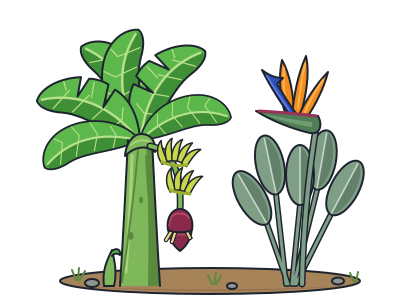
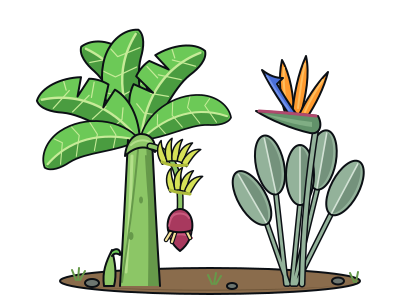
A group of living things
Bananas and gingers
Zingiberales
Bananas, ginger and the bird-of-paradise flower all belong to one group of big-leaved tropical plants.
This branch is shown at about 75 million years ago; its age is a rough estimate.
You and bananas and gingers meet in the Eukaryotes branch, shown at about 1.8 billion years ago (on 28 July, in a calendar from life's shared ancestor to today).
The banana in your fruit bowl and the ginger in your spice rack are relatives. They belong to one group of big-leaved tropical plants. The same group includes turmeric, cardamom, cannas, prayer plants and the bird-of-paradise flower. Altogether there are about 2,500 kinds, split into eight families.
Most of them grow in the wet tropics of Asia, Africa and the Americas. Most are large plants with no wood, and they grow from rhizomes. Their leaves usually have a stalk and a broad blade with fine parallel veins. That is why banana leaves often tear into neat strips.
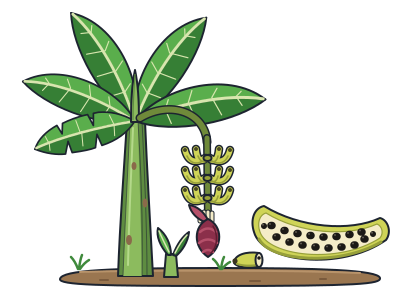
A banana plant looks like a tree, but it is not one. Its 'trunk' is a false stem made of leaf bases wrapped tightly together. That is why the banana is called the largest flowering plant without wood.
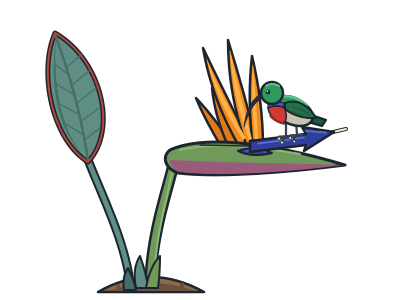
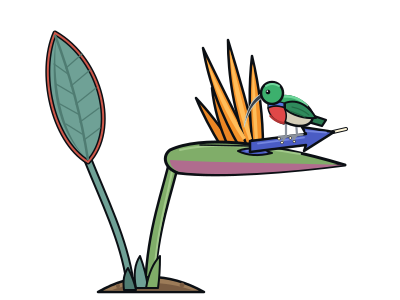
Many members have showy flowers. In some, parts that would normally make pollen have turned into petal-like shapes that attract visitors. Insects, birds, bats and even lemurs pollinate plants in this group. The bird-of-paradise flower suits perching birds such as weavers. When one perches on the flower's stiff, beak-shaped sheath to drink nectar, its weight opens the blue petals and dusts its feet with pollen.
Ginger is gone from the wild
Ginger first came from the islands of Southeast Asia, but it no longer grows in the wild anywhere. It survives only because people grow it, and in 2023 India grew about 45% of the world's ginger.
A banana is a berry
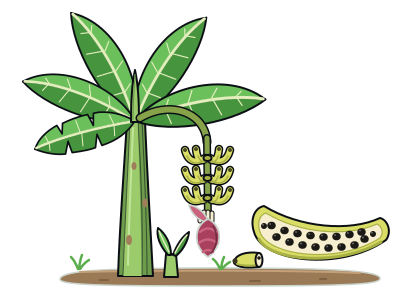
To a botanist, a banana counts as a berry. Shop bananas have no hard seeds, just tiny dark specks, but wild bananas are packed with hard seeds about 5 millimetres across.
A long way from home
The bird-of-paradise flower grows wild in South Africa. It reached Britain in 1773, and today it is the official flower of Los Angeles.
Inside bananas and gingers
- BananaThe 'tree' is really a giant herb, and wild bananas are full of hard seeds.
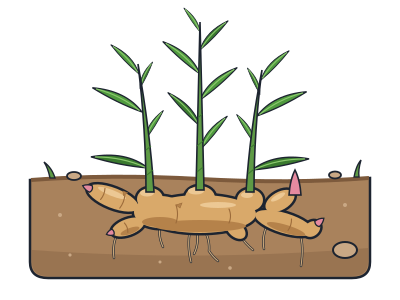
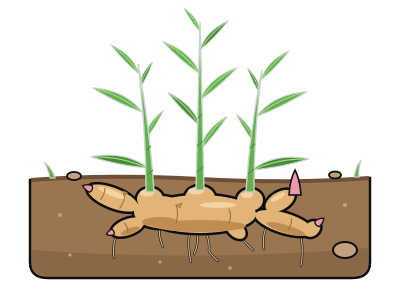
- GingerThe spice is an underground stem, not a root.
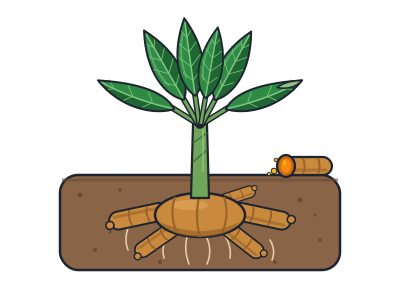
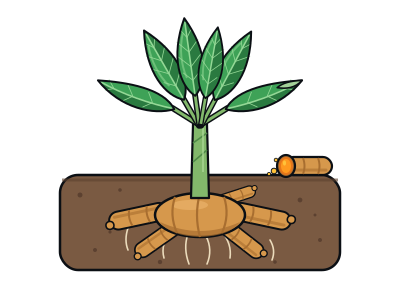
- TurmericA ginger relative whose bright orange root colours curries and robes.
- Bird of paradise flowerIts flower looks like a crested bird, and sunbirds open it by standing on it.