A group of living things
Animals and their single-celled cousins
Holozoa
Every animal, you included, plus the tiny single cells that are our closest non-animal cousins.
This branch is shown at about 1 billion years ago; its age is a rough estimate.
You are part of this group. See how.
You belong to this group, and so does every other animal, from sponges to whales. Animals' closest relatives outside the animal kingdom are not big creatures at all. They are single cells, far too small to see without a microscope. Studying them helps scientists work out how animal bodies first began.
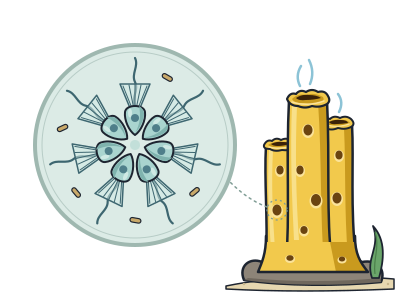
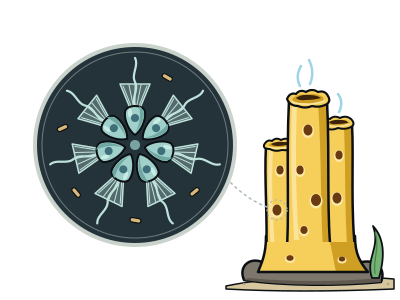
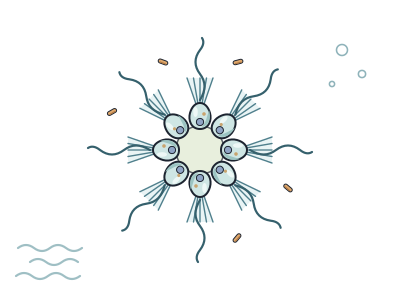
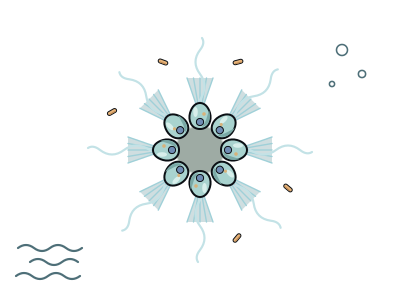
The closest of these cousins are the collared flagellates. Each cell has one whip-like tail ringed by a collar of tiny fingers. The tail beats to make a water current, and bacteria get trapped on the collar and eaten. Sponges feed using cells that look strikingly similar, which is one reason scientists find these cousins so interesting.
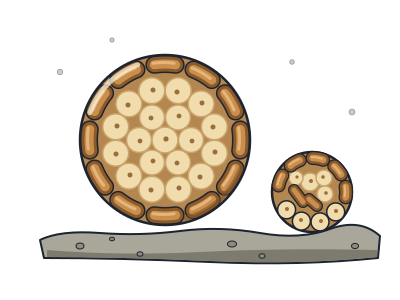
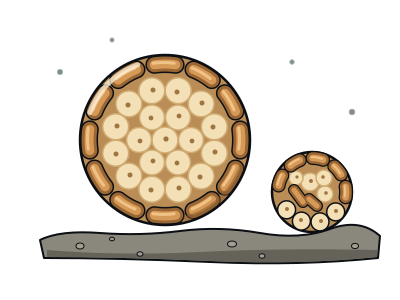
Some of these cousins can live for a while as groups of cells, each in its own way. One collared flagellate makes balls of about 4 to 50 cells when a cell divides and the new cells stay stuck together. Capsaspora, a tiny amoeba, gathers separate cells into clumps. Sphaeroforma, a cousin first found living with a small Arctic crustacean, grows into one big cell with up to 128 nuclei, then splits into many small cells.
Their genes hold a surprise too. Many genes once thought to belong only to animals, such as ones that help cells stick together and send signals, are already found in these single cells. So animal bodies seem to have been built in large part by giving old genes new jobs, not only by inventing new ones.
A 'whole animal' name
The group's scientific name comes from Ancient Greek and means 'whole animal'.
A lucky lab accident
Scientists stumbled on what makes the ball-shaped colonies form when one mix of antibiotics set off a burst of them. The trigger turned out to be a bacterium, and it is the same kind of bacterium the cells also eat.
Cells that flip in the dark
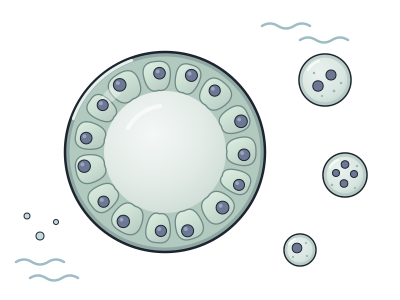
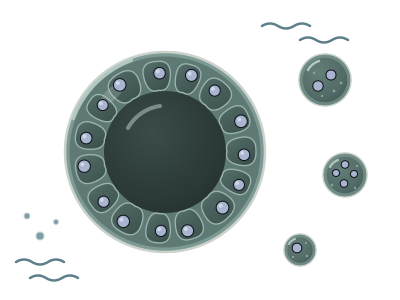
One collared flagellate from splash pools on the Caribbean island of Curaçao forms cup-shaped sheets of cells. When it gets dark, the sheet flips inside out into a ball and swims faster.
Inside animals and their single-celled cousins
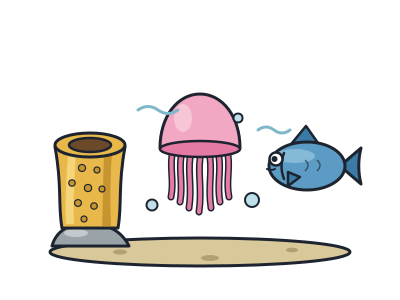
- AnimalsMany cells working as one body that eats other life; from sponges to blue whales.
- Collared flagellateAnimals' closest living single-celled relative; bacteria can trigger it to form flower-like colonies.
- CapsasporaA tiny amoeba living in snail blood that already has many genes animals use to build bodies.
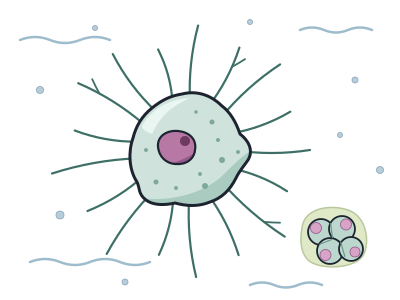
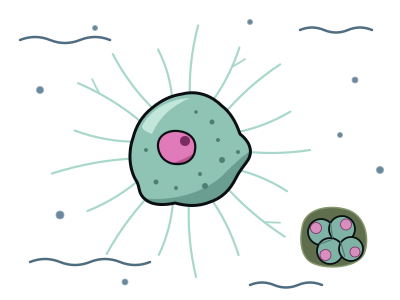
- IchthyosporeanA single-celled relative of animals that divides its insides like an early embryo.