A species
Ichthyosporean
Sphaeroforma arctica
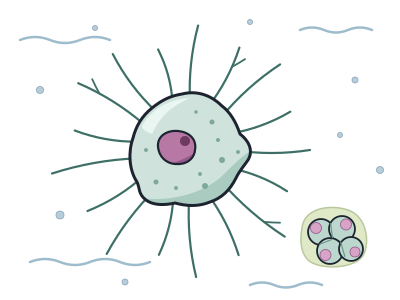
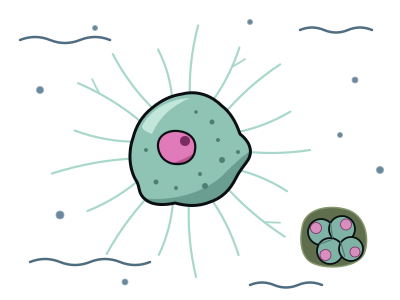
A single cell from cold Arctic seas that splits its insides like an early embryo.
You and the ichthyosporean meet in the Animals and their single-celled cousins branch, shown at about 1 billion years ago (on 6 October, in a calendar from life's shared ancestor to today).
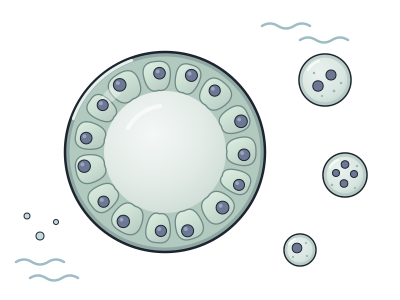
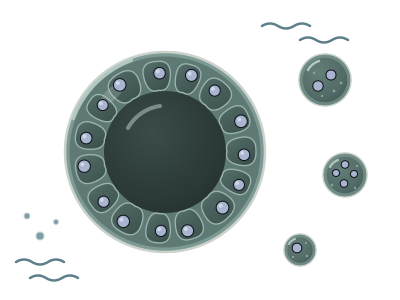
This tiny ball-shaped cell is a distant cousin of animals, and it does something remarkable. When it reproduces, it builds a sheet of cells that looks very like the early stage of a fruit-fly embryo. Yet it is not an animal, and it is not an embryo. It is a single living cell from cold Arctic seas.
As it grows, the nuclei inside it all double at the same moment: one becomes two, two become four, and so on. This happens about every 11 to 12 hours, like a ticking clock. A well-fed cell grows bigger than a hungry one, but the clock keeps the same time. Early fruit-fly embryos use the same kind of steady timer, only far faster. In the end, one big cell holds up to about 128 nuclei.
Next, its outer membrane folds inwards. It is pulled by actin and myosin, the same proteins animal cells use to pinch and squeeze. This walls off each nucleus into its own tiny cell, making a single layer of cells lining the inside of the ball.
Then the big cell bursts, and dozens of small newborn cells spill out. Each one goes its own way and starts the cycle again. They never stay together to build a body.
Not from a fish
Its group's name means 'fish spores', because many relatives are parasites of fish and other animals. But this one was first found living with a small Arctic sea crustacean, a sand-hopper-like animal.
Animal-style gene switches
It makes microRNAs, tiny molecules that help switch genes on and off. Scientists once thought these were special to animals and plants.
Warmth speeds it up
Scientists grow it in salty broth at about 12°C. In warmer conditions its nuclei divide faster, but each cell still ends up with about the same number.
Next to it on the tree
- AnimalsMany cells working as one body that eats other life; from sponges to blue whales.
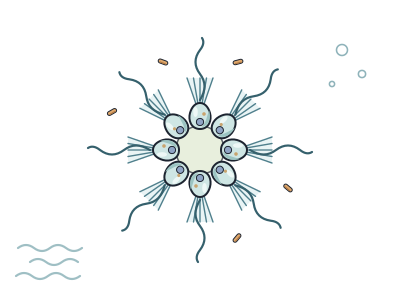
- Collared flagellateAnimals' closest living single-celled relative; bacteria can trigger it to form flower-like colonies.
- CapsasporaA tiny amoeba living in snail blood that already has many genes animals use to build bodies.