An extinct species
Bicellum †
Bicellum brasieri
A billion-year-old ball of two kinds of cell from an ancient Scottish lake
Known from about 1,000 million years ago.
You and the bicellum meet in the Fungi and animals branch, shown at about 1.3 billion years ago (on 10 September, in a calendar from life's shared ancestor to today).
About a billion years ago, a tiny ball of cells lived in a lake in what is now the north-west Scottish Highlands. Its remains were kept in stone in the sediment at the bottom of the lake. It was made of two different kinds of cell, and that is what its name means. Having different types of cell in one body is one of the early steps on the road to animals.
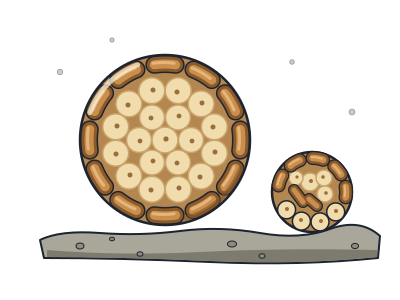
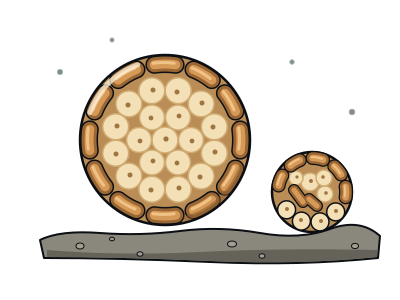
Its fossils show a solid ball of tightly packed, roughly round cells with thin walls. Around the outside was a single layer of long, sausage-shaped cells with thicker walls. The whole ball was only up to about 0.03 mm across, roughly a third the width of a human hair.
Some fossil clusters have a mix of round and long cells. Researchers think these show it growing, with the long cells moving out to the edge. It looks a lot like some living single-celled relatives of animals. It was not an animal itself, and nobody knows how it fed or what colour it was.
Most fossils from this time come from the sea. This one came from fresh water, which hints that early steps toward animals may have happened in lakes too.
Named for a fossil hunter
Its species name honours Martin Brasier, an Oxford palaeontologist who studied the earliest fossils. It was named after he died in 2014.
Sliced with diamond saws
The fossils sit inside small black lumps of phosphate mineral, about a centimetre thick. Scientists cut them into very thin slices with diamond saws so they could look at them under a microscope.
A very old toolkit
The lead researcher said it shows that the genetic tools for cells sticking together and sorting into groups already existed a billion years ago. Animals may have taken up a system like this about half a billion years later.