A species
Capsaspora
Capsaspora owczarzaki
A tiny amoeba in snail blood that carries many of the genes animals use to build bodies.
You and the capsaspora meet in the Animals and their single-celled cousins branch, shown at about 1 billion years ago (on 6 October, in a calendar from life's shared ancestor to today).
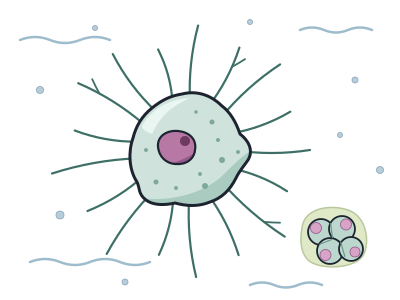
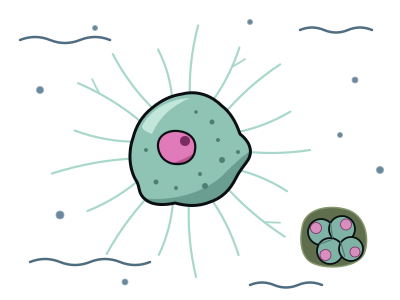
Inside the blood of a tropical freshwater snail lives a tiny single cell with long, hair-like arms. It looks like a simple amoeba. Yet it carries many genes that animals, including us, use to build bodies. It is one of the closest single-celled relatives of animals, although collared flagellates are closer still.
Animal cells use a set of proteins to grip the material around them. Scientists once thought that only animals had this set. This little cell has all of it. It even has its own version of Brachyury, a gene that animals use while an embryo forms its body layers.
It does not use these genes to grow a body. Instead it uses them for single-celled jobs, such as gripping surfaces and sticking to other cells. It also changes form over time. It crawls about on its thin arms and divides. Later, many cells can clump together into a small, sticky mass. It can also turn into a hardy resting ball called a cyst.
It is not an ancestor of animals. It is a living cousin. Studying it helps scientists work out which tools animals inherited from their single-celled past and then reused in new ways.
Enemy of a parasite
Its host snail can also carry the young of a parasitic worm that causes a human disease called schistosomiasis. In lab dishes, this little cell attacks and kills those young worms. It may do the same inside the snail.
Happy without its snail
Scientists grow it in the lab in a nutrient broth at about 23°C, with no snail needed. That makes it easy to study for clues about how animals began.
Many paths to many cells
Living things made of many cells have evolved separately at least 25 times. This has happened in animals, fungi, plants, slime moulds and seaweeds.
Next to it on the tree
- AnimalsMany cells working as one body that eats other life; from sponges to blue whales.
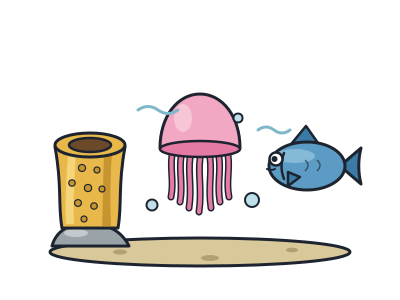
- Collared flagellateAnimals' closest living single-celled relative; bacteria can trigger it to form flower-like colonies.
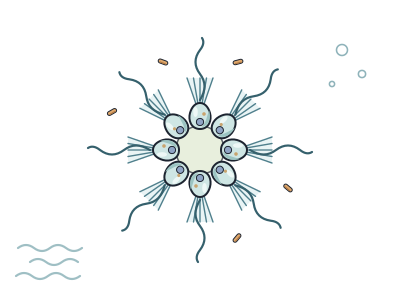
- IchthyosporeanA single-celled relative of animals that divides its insides like an early embryo.