A species
Garden pea
Pisum sativum
The humble garden plant that revealed how traits pass from parents to offspring.
You and the garden pea meet in the Eukaryotes branch, shown at about 1.8 billion years ago (on 28 July, in a calendar from life's shared ancestor to today).
In a monastery garden in Brno, in what is now the Czech Republic, a monk named Gregor Mendel used this everyday plant to solve one of life's big puzzles: how parents pass traits to their offspring. Between 1856 and 1863 he grew and tested thousands of plants, and most of them were peas. He tracked seven either-or traits, such as round or wrinkled seeds, yellow or green seeds, and tall or dwarf plants.
Mendel crossed pea varieties that always bred true. In the second generation, the two forms of each trait turned up in a steady ratio of about three to one. This gave us the idea of dominant and recessive traits. Peas suited the job well because they can pollinate themselves, which kept each line pure. Even so, his work was mostly ignored until 1900, when three other scientists came to similar results and rediscovered his paper.
The pea belongs to the legume family, together with soybeans, peanuts and the sensitive plant. It is one of the biggest plant families on land, with about 19,400 species. Like many of its relatives, the pea has small bumps on its roots that house bacteria. These bacteria turn nitrogen from the air into a form plants can use, so growing peas makes the soil richer.
A 160-year mystery solved
In 2025, an international team led by scientists in China and the UK found the last unknown genes behind Mendel's seven traits. Yellow pods, for example, come from a big missing stretch of DNA next to a chlorophyll-making gene. This leaves the pods with far less of their green colouring.
Secretly a fruit
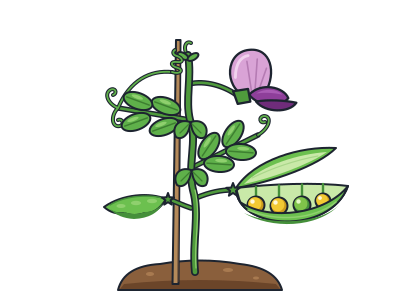
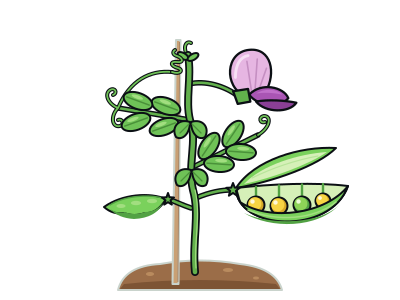
A pea pod is actually a fruit, because it grows from the part of the flower where the seeds form. Each pea inside is a seed.
Butterfly flowers
Pea flowers are shaped like butterflies. They have one large upright petal called the banner, two side petals called wings, and a boat-shaped part at the bottom called the keel.
Next to it on the tree
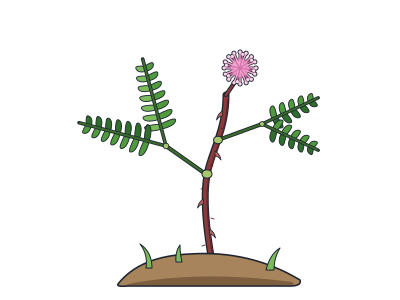
- Sensitive plantFolds its leaves within seconds when touched.
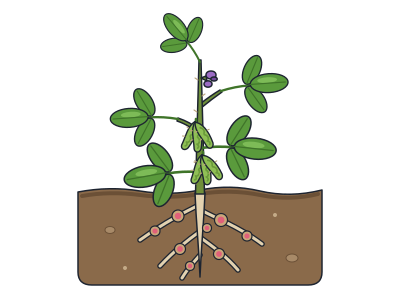
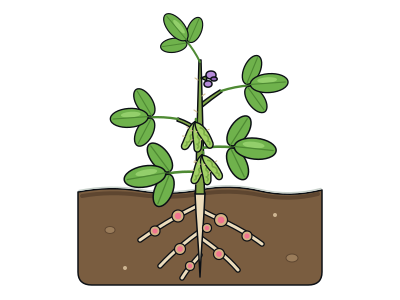
- SoybeanOne of the world's biggest crops, rich in protein thanks to its root bacteria.
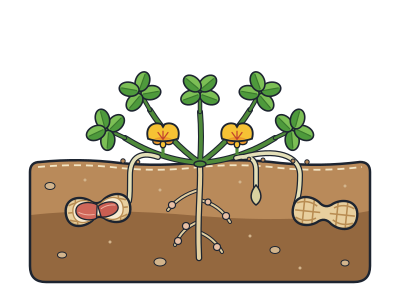
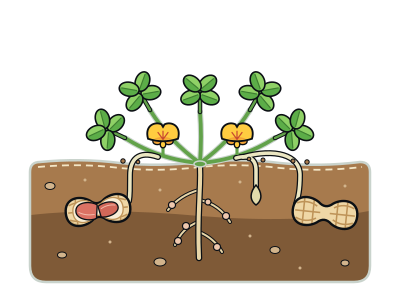
- PeanutNot a nut: its flower stalks dive into the soil so pods ripen underground.
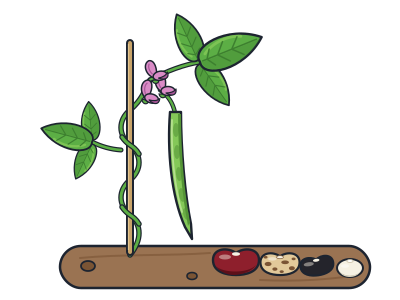
- Common beanKidney, pinto, black and green beans are all one species from the Americas.
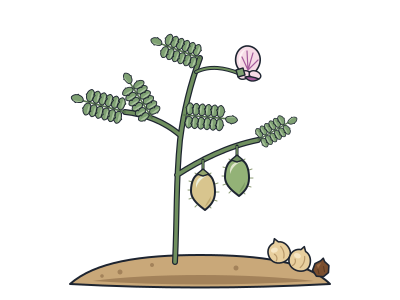
- ChickpeaThe bean behind hummus, grown for over 9,000 years.
- Umbrella thorn acaciaThe flat-topped tree of African savanna, whose long thorns slow down browsers such as giraffes.