A group of living things
Gnetophytes
Gnetales
Three strange cone plants that look nothing alike
This branch is shown at about 155 million years ago; its age is a rough estimate.
You and gnetophytes meet in the Eukaryotes branch, shown at about 1.8 billion years ago (on 28 July, in a calendar from life's shared ancestor to today).
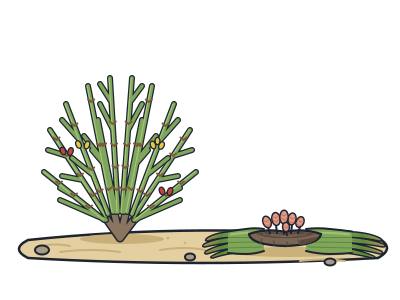
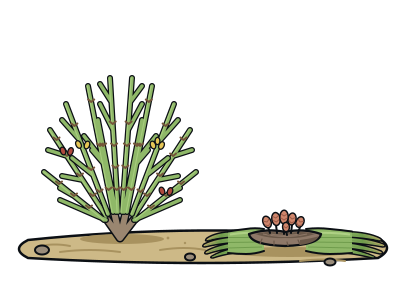
Picture a desert plant with only two leaves, a jointed green shrub and a vine with broad, glossy leaves. They hardly look related, but these three strange plants make up one small group of cone-bearing seed plants. On the tree they sit beside conifers, ginkgo and cycads. Only three living branches of the group survive, and each one is placed in its own family.
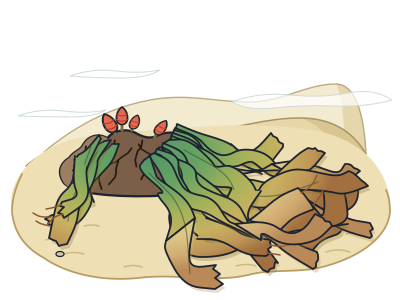
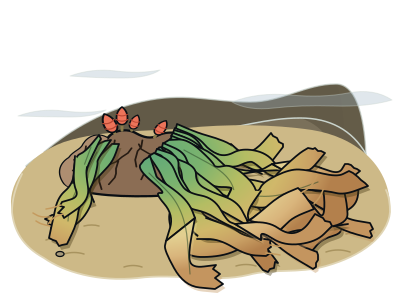
The desert plant is Welwitschia. It grows wild only along about 1,000 kilometres of almost rainless coast in Namibia and Angola. In its whole life it grows just two strap-like leaves. They keep growing from the base and can reach about 4 metres, about as long as a car. Over time they split into ribbons, so the tangled heap looks like many leaves.
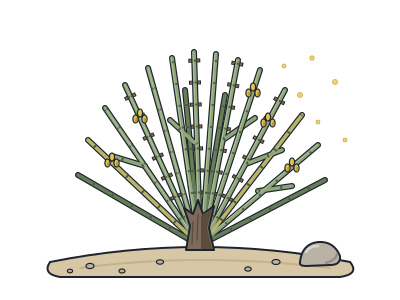
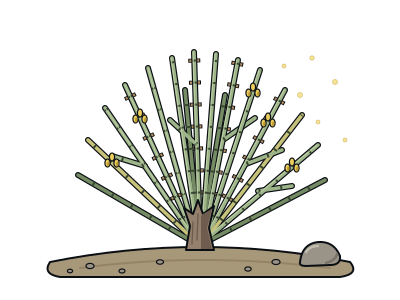
The shrub is Ephedra. It has about 74 kinds, found in dry lands on every continent except Australia and Antarctica. Its green, jointed stems do the work of leaves, and its real leaves are tiny scales. Gnetum is mostly woody vines in tropical forests, with broad leaves like a flowering plant's. One kind, melinjo, is a tree. In Indonesia its seeds are made into crackers.
These plants have water-carrying tubes in their wood, like flowering plants and unlike living conifers, ginkgo and cycads. But genome studies suggest this likeness evolved separately. They carry their seeds in cones, not flowers.
Fly-carried pollen
Each Welwitschia is either male or female. Flies visit the cones for their nectar and carry pollen from plant to plant.
Not a giant baby
Early botanists thought Welwitschia was a 'giant seedling'. In fact, it gets its odd shape because the growing tip of its shoot stops working early in life.
Ancient shrubs
The oldest known Ephedra fossils are about 125 million years old, from a time when dinosaurs were still alive.