A species
Welwitschia
Welwitschia mirabilis
A desert plant that keeps the same two leaves for its whole life, sometimes for more than a thousand years.
You and the welwitschia meet in the Eukaryotes branch, shown at about 1.8 billion years ago (on 28 July, in a calendar from life's shared ancestor to today).
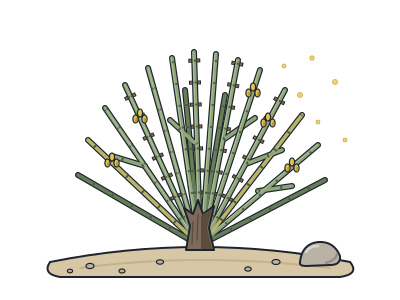
Most plants grow new leaves and drop old ones, season after season. This desert plant makes just two, and keeps them for its whole life. Some wild plants are about 1,500 years old, so the same two leaves have been growing for well over a thousand years. Scientists describe them as the longest-lived leaves of any plant.
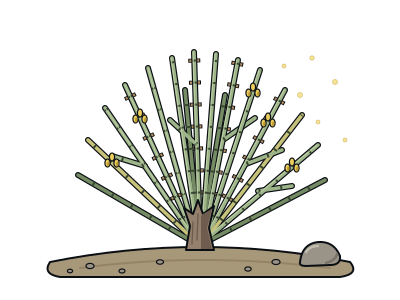
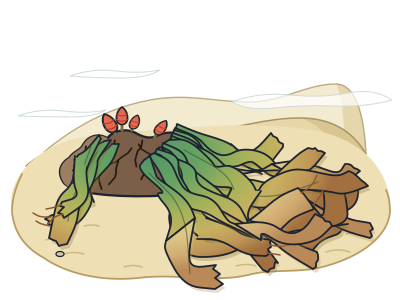
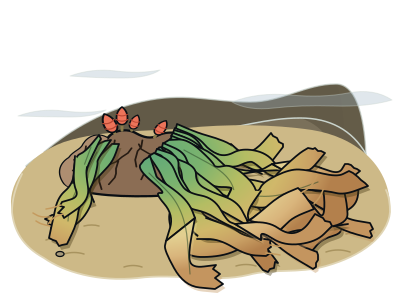
The leaves grow from the base, a bit like your fingernails, adding about 10 to 15 cm a year while the old tips wear away. They can reach about 6 m long, which is longer than a family car. Over the centuries the wind tears them into many ribbons. An old plant looks as if it has dozens of leaves, and people have compared it to a giant spider or a heap of rubbish.
It is not a cactus or a flowering plant. It is a gymnosperm, part of the same big group as pines, ginkgo and the sago palm. Its closest living relatives are tropical plants called Gnetum. There are separate male and female plants. Both grow small cones, often reddish, that make nectar, and flies are the main pollinators.
It grows wild only in the Namib Desert of southern Angola and northern Namibia, mostly within about 80 km of the sea. Much of this land gets less than 50 mm of rain a year, but cool sea fog often rolls in.
A giant instruction book
Its full set of DNA is about 6.8 billion letters long, more than twice the length of ours.
National symbol
It appears on Namibia's coat of arms. One local name, 'onyanga', is translated as 'onion of the desert'.
Waiting for rain
Its winged seeds blow on the wind and sprout only in wet years. A seedling lives on two small seed leaves for about a year and a half before its two lifelong leaves take over.