A species
Melinjo
Gnetum gnemon
A cone plant in flowering-tree disguise, whose seeds become crunchy crackers
You and the melinjo meet in the Eukaryotes branch, shown at about 1.8 billion years ago (on 28 July, in a calendar from life's shared ancestor to today).
With its broad, glossy leaves in neat pairs, melinjo looks like any other tropical fruit tree. But it never makes a single flower. Melinjo is a cone plant, part of the same big group as pines and other conifers.
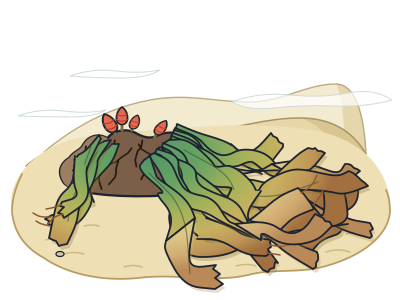
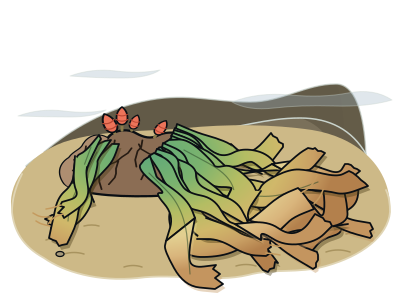
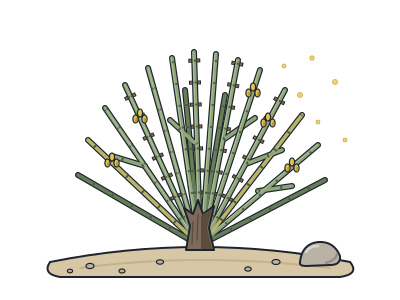
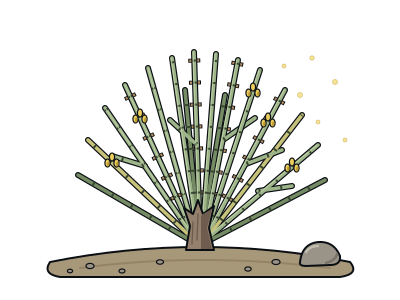
It belongs to a small group called the gnetophytes, which has just three living branches. Its nearest relatives on the tree are Welwitschia, a desert plant that grows only two long, strap-like leaves, and Mormon tea, a shrub with thin green stems and tiny scale-like leaves. The three look so different that you would never guess they are family.
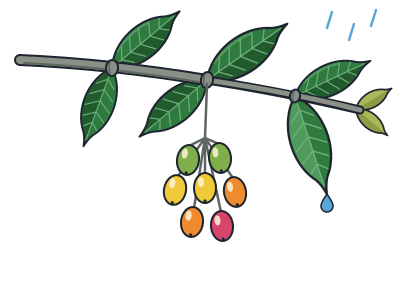
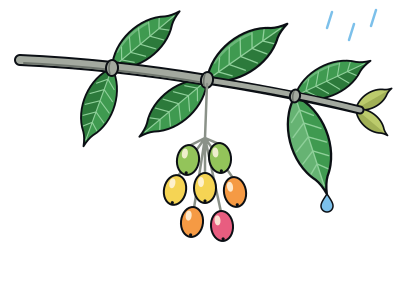
Instead of flowers, melinjo grows slim cone-like spikes, each about as long as your thumb. Male and female spikes grow on separate trees. The seeds hang in clusters. Each is about the size of an olive, with a fleshy coat that ripens from yellow to orange, pink or purple. They look like fruit, but they are seeds that are not wrapped inside a true fruit.
In Indonesia, people roast and peel the seeds, pound each one flat, dry the discs in the sun, then deep-fry them. They puff up into golden, slightly bitter crackers called emping. These are often eaten with dishes such as gado-gado and nasi goreng.
A tree among climbers
Melinjo's genus has about 30 to 40 species, found in tropical rainforests of Asia, West Africa, Fiji and northern South America. Most of them are woody climbing vines, so melinjo is unusual in growing as a tree.
Pipes like a flowering plant
Unlike other cone plants, gnetophytes have water-carrying tubes called vessels in their wood, just as flowering plants do. Because of features like this, scientists once thought they were the closest relatives of flowering plants. DNA studies later showed that idea was wrong.
A garden crop
Melinjo is the main species in its genus that people farm. It grows in small orchards and home gardens, especially in Java. People also cook the young leaves in soups, and the inner bark was once made into rope and fishing nets.