An extinct species
Cordaites †
Cordaites
Coal-age trees with belt-like leaves, and close relatives of conifers
Lived about 320–252 million years ago.
You and the cordaites meet in the Eukaryotes branch, shown at about 1.8 billion years ago (on 28 July, in a calendar from life's shared ancestor to today).
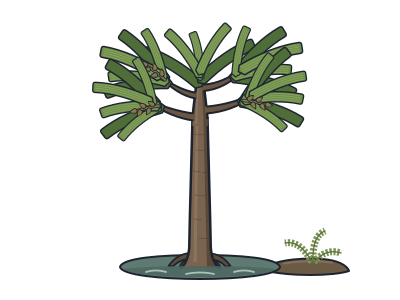
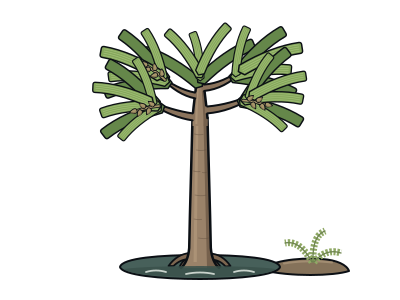
Picture a tall, straight tree topped with long, leathery leaves shaped like belts. Plants like this lived about 320 to 252 million years ago, before the first dinosaurs. They made seeds and simple cones, and scientists think they were close relatives of today's conifers.
On lowland ground most trunks were about 10 metres tall, and some reached 20 to 30 metres. The tallest were about as tall as a ten-storey building. The leaves grew in a spiral and bunched near the branch tips. Each one was usually 20 to 70 centimetres long, and the longest were about as long as a person's arm. Many fine veins ran side by side along each leaf, and there was no strong central vein. The leaves look a bit like grass or palm leaves, but these plants were not flowering plants.
Fossils show that the trunk had a wide core, called the pith, split by closely spaced cross-walls. Fossil casts of this core look like the rungs of a ladder. Slim, cone-like shoots up to about 30 centimetres long grew among the leaves. Pollen and seeds were made on separate shoots. Pictures show green leaves and brown bark, but that is a guess, because fossils do not keep colour.
They did not live only in one kind of place. In the steamy, peat-filled swamps that later turned into coal, some grew smaller and bushier, like shrubs. They also grew on drier ground.
One plant, many names
The leaves, cones, seeds and trunk cores were usually found apart, so each part got its own name. The leaves are called Cordaites, the cones Cordaitanthus, the seeds Cardiocarpus and the pith casts Artisia.
Hard to find whole
The leaves were so long that complete ones are rarely found as fossils. At Mazon Creek in Illinois, one kind reached about 64 centimetres long.
A modern look-alike
New Zealand's kauri trees have flat, leathery leaves with many fine parallel veins and no central vein, rather like these ancient ones, though much shorter. But kauri are modern conifers, not survivors of this group.
Next to it on the tree
- Flowering plantsFlowers and fruit recruited animals as couriers and took over the planet.
- GlossopterisIts tongue-shaped leaves are found in Africa, India, Antarctica and Australia, proving those lands were joined.
- WilliamsoniaA dinosaur-era plant with flower-like cones, an early experiment in flowers.
- Conifers and other gymnospermsSeed plants with naked seeds, usually in cones, from pines to the strange Welwitschia.
- CaytoniaA Jurassic seed plant with seeds wrapped in a cup, long debated as a flowering-plant forerunner.
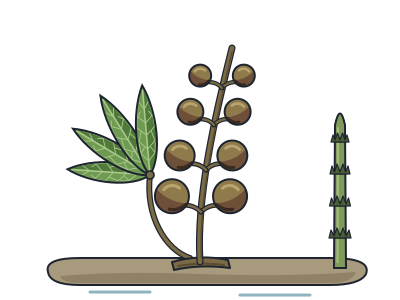
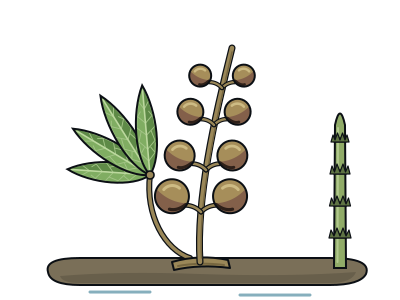
- DicroidiumForked fern-like leaves that carpeted the southern lands while the first dinosaurs walked.