A species
Mormon tea
Ephedra nevadensis
A leafless desert shrub of green, jointed sticks that early settlers brewed into tea.
You and the mormon tea meet in the Eukaryotes branch, shown at about 1.8 billion years ago (on 28 July, in a calendar from life's shared ancestor to today).
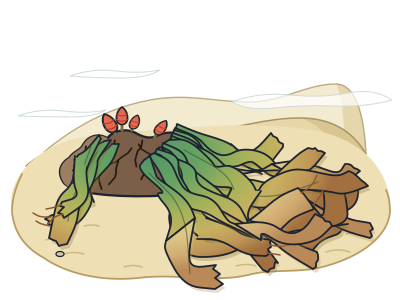
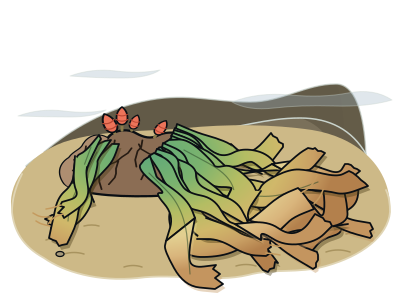
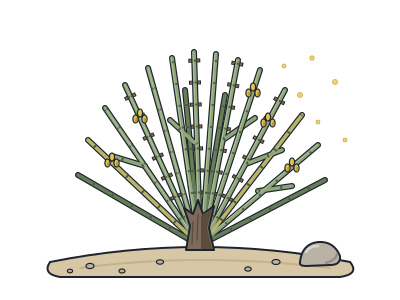
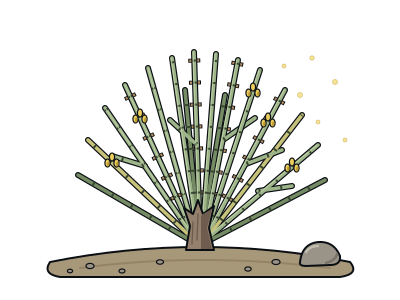
Picture a pile of green sticks in the desert, about waist high, with no leaves in sight. That is Mormon tea. Its stems have joints, a bit like bamboo. Early Mormon settlers in Utah are said to have soaked the stems in hot water and drunk the brew in place of coffee and tea, which their church's health rules advised against. They called it 'Brigham tea'. Some Native American peoples also made a tea from the plant to treat stomach and kidney complaints.
It looks a little like a rush or a horsetail, but it is neither. It is a seed plant that grows cones, and most DNA studies place its group with the conifers. Apart from other kinds of ephedra, its closest living relatives are two quite different plants. One is the very odd Welwitschia, which grows only in the Namib Desert region of Angola and Namibia. The other is melinjo, from wet tropical forests. Those two are each other's nearest kin, and Mormon tea's group sits on a branch right beside them.
It does have leaves, but they have shrunk to tiny scales, two at each joint. The green stems do the work of making the plant's food from sunlight. It has no flowers. Male plants carry small pollen cones, and female plants carry little round seed cones with smooth brown seeds. It grows on dry, rocky slopes from Oregon down to Mexico and can get by on about 18 cm of rain a year.
An acquired taste
A Utah botanist said the brew looks almost a glowing yellow-orange but tastes 'like you boiled up an old sock' unless you add plenty of cream and sugar.
Built to last
Old photographs of ephedra shrubs in Arizona suggest these plants can live for more than 100 years. Mormon tea's thick, woody roots can reach about 2 metres deep, deeper than a tall adult is tall.
Food for grazers
Mule deer, bighorn sheep and pronghorn all browse it, especially in spring and late summer when fresh shoots grow. In winter, when little else is green, it can be an important food.