A group of living things
Cycads
Cycadales
Stout, palm-like cone plants whose family line is older than the dinosaurs
This branch is shown at about 265 million years ago; its age is a rough estimate.
You and cycads meet in the Eukaryotes branch, shown at about 1.8 billion years ago (on 28 July, in a calendar from life's shared ancestor to today).
The sago palm in a garden pot looks like a little palm tree, but it is not a palm at all. Cycads are cone-bearing seed plants. They are more closely related to the ginkgo tree and to conifers than to palms or any other flowering plant. Their family line is older than the dinosaurs. The oldest clear cycad fossils, found in China, are about 265 to 272 million years old.
That does not make today's cycads unchanged 'living fossils'. Most living species appeared in roughly the last 12 million years. There are about 300 to 340 named species, growing in warm parts of the Americas, Africa, Asia, the Pacific islands and Australia.
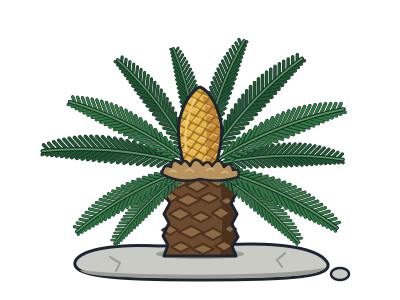
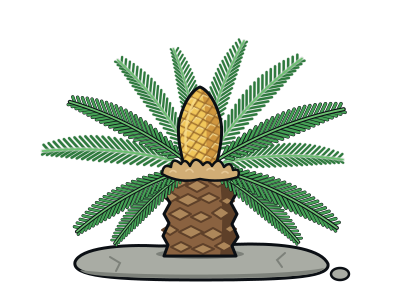
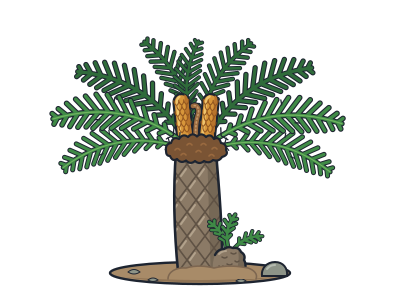
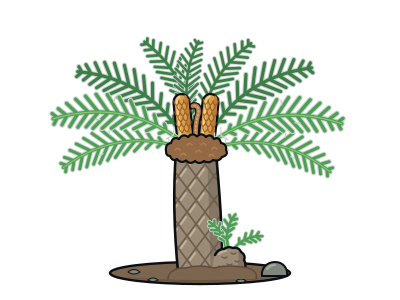
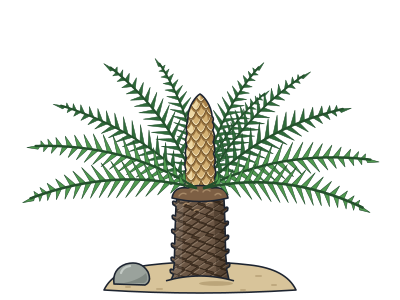
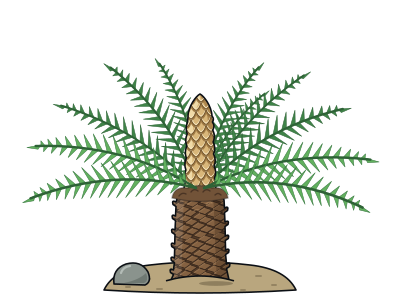
A cycad is a stout plant with a thick trunk, or an underground stem. Its crown of stiff, feather-shaped leaves spreads out like a shuttlecock. Cycads have no flowers and no fruit. Each plant is either male or female. Males make pollen cones and females make seeds. Special roots grow upwards and house tiny cyanobacteria, which give the plant nitrogen like a built-in fertiliser.
Today cycads are thought to be the most threatened plant group in the world. About 60% of the species that have been checked are at risk of dying out.
Swimming sperm
Unlike most seed plants, cycads have sperm that swim. A scientist named Seiichiro Ikeno discovered them in the sago palm in 1896.
Big enough to see
One cycad makes the longest sperm of any plant, about 0.4 mm long. That is big enough to see without a microscope.
Warm, smelly cones
In one Australian cycad, the male cones heat up each day and give off strong smells that drive tiny insects called thrips away. As the cones cool, the smell changes and draws the thrips back. The thrips then carry pollen to the female cones.