A species
Common juniper
Juniperus communis
The world's most widespread conifer, and the plant that gives gin its name.
You and the common juniper meet in the Eukaryotes branch, shown at about 1.8 billion years ago (on 28 July, in a calendar from life's shared ancestor to today).
No other conifer grows across as much of the world as common juniper. It circles the cool northern half of the planet, through Europe, Asia and North America. You can find it from the Arctic tundra to about 30 degrees north, and from the seashore up to high mountain slopes.
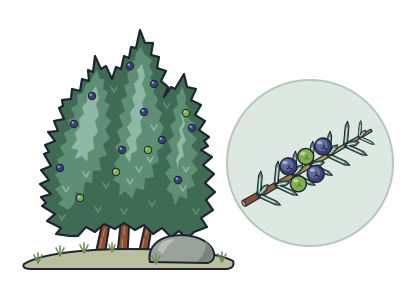
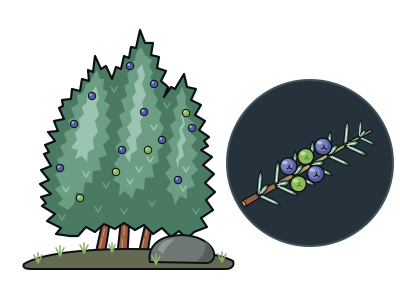
If you have ever smelt gin, you have met this plant. Rules in Europe and the USA say gin must taste of juniper, and in Europe it must be the main flavour. Even the word 'gin' comes from 'genever', which goes back to the Latin name for juniper. The blue 'berries' are not really berries. They are cones whose scales have turned soft and fleshy and grown together. Each one takes about 18 months to ripen from green to purple-black, with a dusty blue coating.
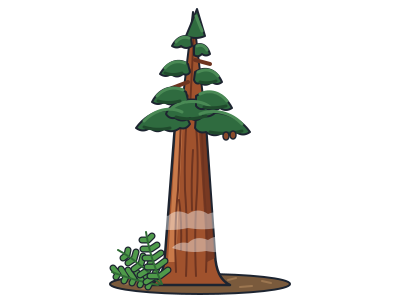
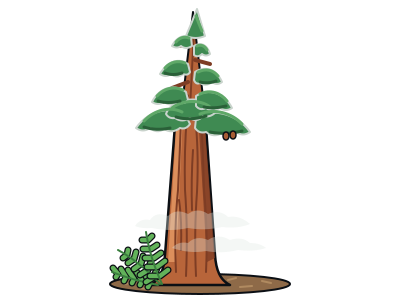
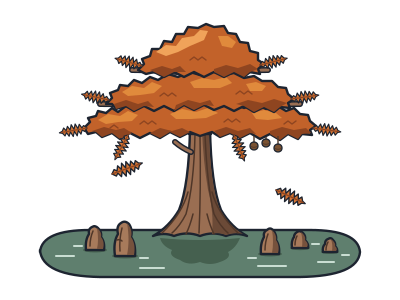
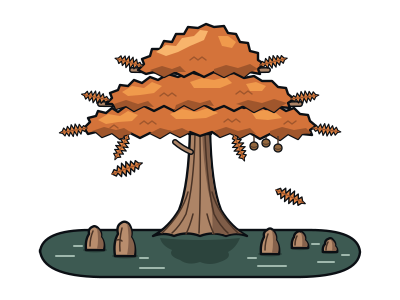
This often low, prickly bush belongs to the cypress family, the same family as the towering redwoods and the bald cypress. In windy, exposed places it may lie flat along the ground. Elsewhere it can grow into a small tree about 10 to 12 metres tall.
Each plant is either male or female, and only females carry the berry-like cones. The wind carries pollen between them. Birds eat the cones and spread the seeds in their droppings. In North America these include American robins and cedar waxwings.
Record breaker
The tallest common juniper on record grows at Ryd in Sweden. It measured about 17 metres in 2018, roughly as tall as a five-storey building.
Needles in threes
Its short, sharp needles grow in groups of three. Each one has a whitish stripe that gives the bush a silvery-blue shine.
Fire-sensitive
Its leaves are full of resin and burn very easily. A fire usually kills the plant, so juniper is slow to come back after a blaze.