A species
Bald cypress
Taxodium distichum
A swamp conifer that goes bald every winter and grows wooden knees.
You and the bald cypress meet in the Eukaryotes branch, shown at about 1.8 billion years ago (on 28 July, in a calendar from life's shared ancestor to today).
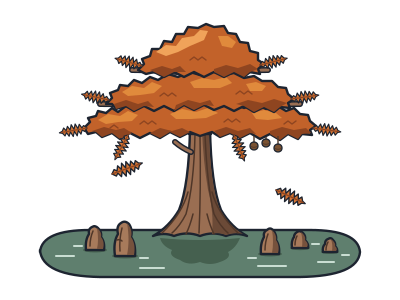
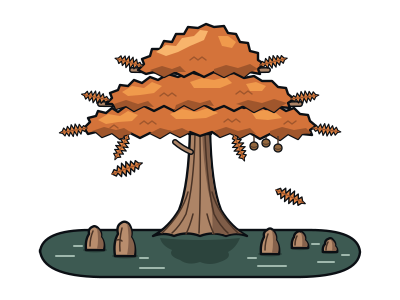
Most conifers stay green all year, but this swamp tree breaks the rule. Each autumn its soft, flat needles turn orange or copper-red. Then they fall, still attached to their small twigs. The tree stands bare all winter, which is why it is called 'bald'. Only a few conifers do this. Around its trunk, woody bumps called knees poke up out of the mud and dark water.
It belongs to the cypress family, along with junipers and redwoods. One redwood, the dawn redwood, also drops its needles. Yet DNA studies suggest the bald cypress is a closer relative of junipers than of redwoods. Apart from its own close kin, such as pond cypress, its nearest cousins are the Chinese swamp cypress and the Japanese cedar.
Knees grow up from the tree's shallow roots. They are usually 30 centimetres to 1 metre tall, roughly knee- to waist-high on an adult. Scientists have puzzled over them for about 200 years. Many people think they work like snorkels, bringing air to drowned roots, but tests have not supported this. They may help steady the tree in soft mud or store food.
Wild bald cypresses grow along swamps and riverbanks in the south-eastern United States, and they can stand in floodwater for long periods. They usually grow about 11 to 36 metres tall, as tall as a 4- to 12-storey building.
Over 2,600 years old
A bald cypress on the Black River in North Carolina was at least 2,624 years old in 2018. It is the oldest known living tree in eastern North America. Its rings show which years were wet and which were dry.
A state symbol
Bald cypress has been the official state tree of Louisiana since 1963.
A forest under the sea
Stumps of an ancient bald cypress forest lie about 18 metres underwater in the Gulf of Mexico, off Alabama. A hurricane uncovered them in 2004. The trees grew during an ice age, when the sea was much lower.