A species
Wood's cycad
Encephalartos woodii
The world's loneliest plant: every one alive is a copy of a single wild male.
You and the wood's cycad meet in the Eukaryotes branch, shown at about 1.8 billion years ago (on 28 July, in a calendar from life's shared ancestor to today).
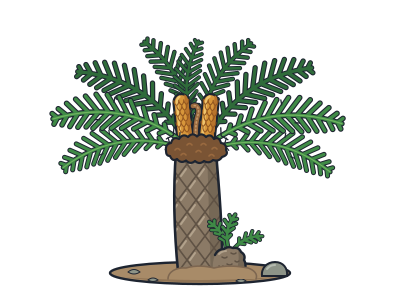
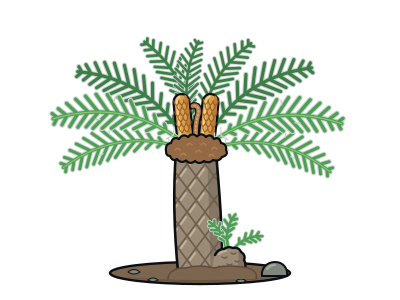
In 1895, a botanist exploring the edge of a forest in South Africa found a plant that nobody has found since. It was a single male, growing as a clump of four stems. No other wild plant of its kind has ever turned up. Today about 500 Wood's cycads grow in gardens around the world, and every one was grown from offshoots that trace back to that first plant. They are all clones of the same male.
In cycads, each plant is either male or female, and it takes both to make seeds. With no female, this cycad cannot reproduce by seed. The last wild stem was taken out of the forest in 1916, and the species is now listed as Extinct in the Wild. Kew Gardens in London calls it the 'world's loneliest plant'.
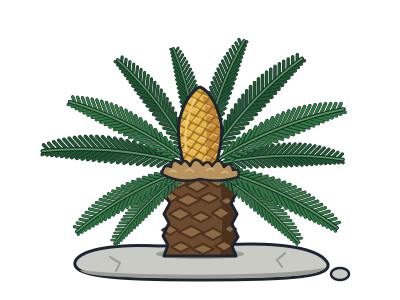
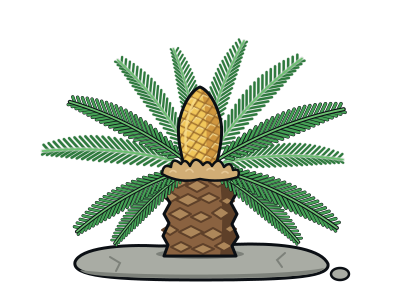
It looks like a short palm tree, but it is not a palm. Cycads are an ancient group of seed plants with 'naked' seeds, like conifers. Their oldest likely fossils are about 300 million years old, from before the dinosaurs. Its neighbour on the tree, the sago palm, is also a cycad, despite its name.
Since 2022, scientists have flown drones over the forest and used artificial intelligence to search for a female. None has been found yet.
A bread tree
It belongs to a group of African cycads called 'bread trees'. People once made food from the starchy core of their trunks, and the group's scientific name comes from Greek words for 'head' and 'bread'.
Kew's first cone
Kew's plant arrived in 1899, but it did not make its first cone until 2004. Male cones are bright yellow-orange and usually about 20 to 40 cm long.
Nearly pure, never fully
Growers have crossed it with a female of a related species, the Natal cycad, then crossed the young plants back to Wood's cycad over several generations. The results are almost pure Wood's cycad, but DNA passed down from the mother still shows their Natal cycad ancestry.