A group of living things
Ciliates
Ciliophora
Single cells that row with beating hairs and carry two kinds of nucleus.
This branch is shown at about 900 million years ago; its age is a rough estimate.
You and ciliates meet in the Eukaryotes branch, shown at about 1.8 billion years ago (on 28 July, in a calendar from life's shared ancestor to today).
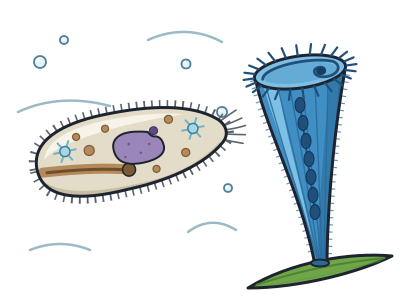
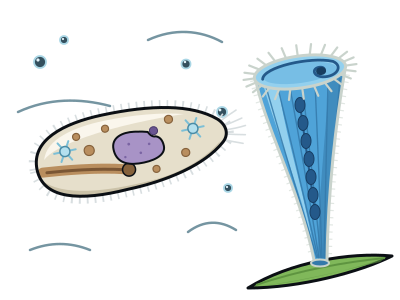
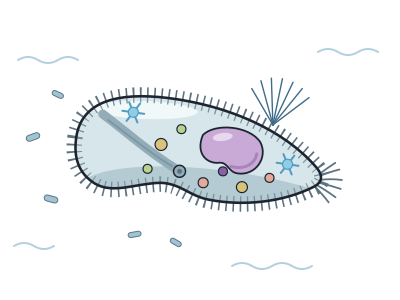
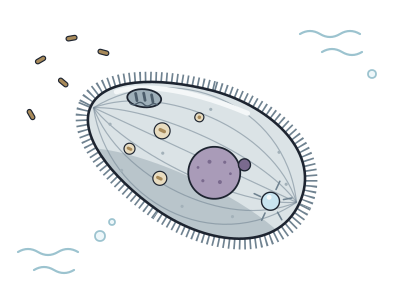
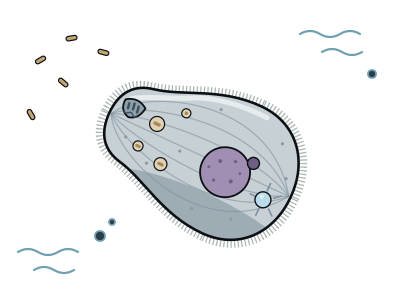
Picture a single cell rowing itself along with thousands of tiny beating hairs. These hairs are called cilia, and they give ciliates their name. A slipper-shaped Paramecium has about 4,000 of them, set in rows along its body. They beat in waves, like wind rippling across a field of wheat. Some ciliates have hairs all over, and others only in rings or tufts. They use them to swim, crawl, hold on, feed and sense the world around them.
Almost every ciliate also carries two kinds of nucleus. A large one runs everyday life, like a working copy of the cell's instructions. A tiny one keeps the master copy of the genes that gets passed on. Two ciliates can join through a little bridge and swap copies of half their master genes, then go their separate ways. This swap does not make new cells. To multiply, a ciliate simply splits in two.
Old names like "animalcule" make them sound like tiny animals, but they are not. On the tree, they sit beside the dinoflagellates and the malaria parasite and its kin. All three groups have flat little sacs just under the cell's surface.
Some ciliates are giants for a single cell. The blue, trumpet-shaped Stentor can stretch to about 2 mm long, big enough to see without a microscope.
Regrows from pieces
If a Stentor is cut into pieces, the pieces can each regrow into a whole, normally shaped cell, as long as they keep part of the large nucleus.
A spring-loaded stalk
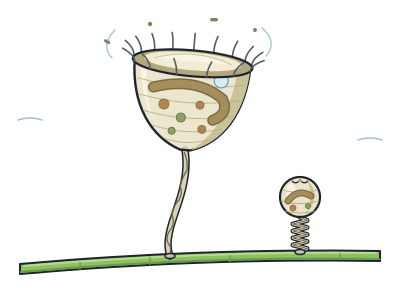
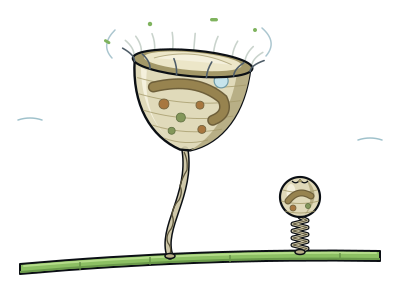
The bell animalcule Vorticella sits on a stalk that can coil like a spring in about 2 thousandths of a second. That makes it one of the fastest-moving living things for its size. Calcium powers the snap, not the fuel cells usually run on.
Borrowed sunlight
Most ciliates eat bacteria, algae or other small cells. A few keep chloroplasts stolen from their food, or team up with microbes that use sunlight, so they get energy from light too.
Inside ciliates
- ParameciumA slipper-shaped cell that rows with hairs and fires tiny harpoons when threatened.
- Trumpet animalculeA blue, trumpet-shaped single cell big enough to see by eye, and able to regrow from a fragment.
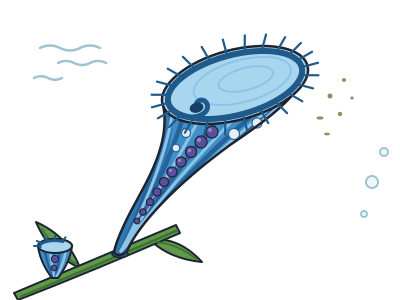
- Bell animalculeA bell on a spring-loaded stalk that snaps shut faster than almost anything alive.
- TetrahymenaA pond ciliate behind two Nobel Prizes: chromosome tips and RNA that acts like an enzyme.
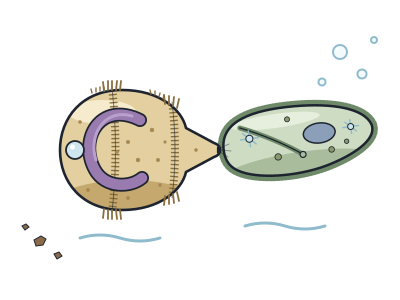
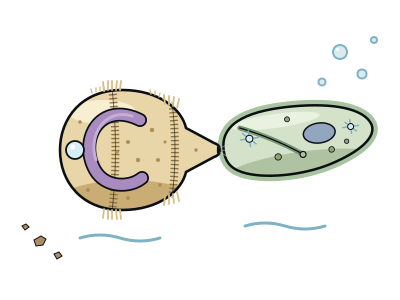
- Barrel ciliateA barrel-shaped hunter that swallows Paramecium whole, prey nearly as big as itself.
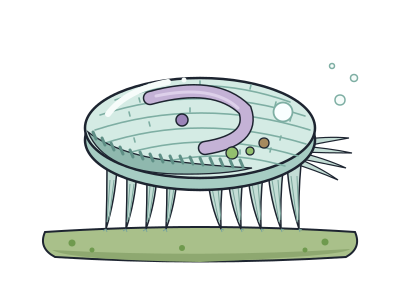
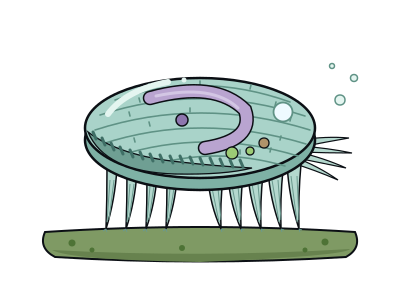
- Walking ciliateInstead of swimming, it strolls on tufts of fused hairs that work like little legs.
Next to it on the tree
- DinoflagellatesArmoured, spinning swimmers behind glowing waves, red tides and healthy coral reefs.
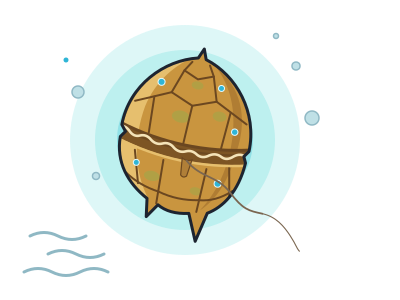
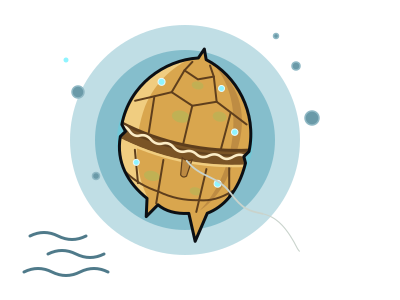
- Malaria parasite and kinParasites that carry a ghost of a plastid from photosynthetic ancestors.
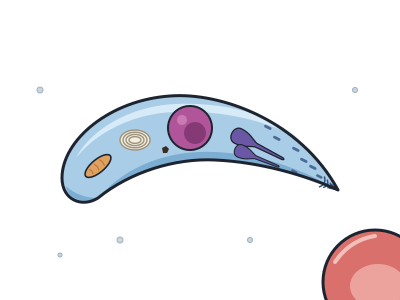
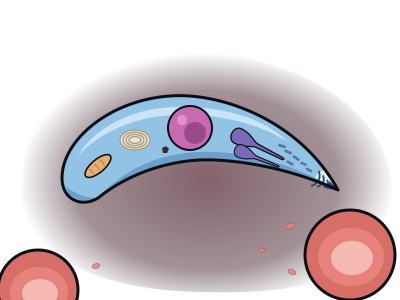
- ChromeraA tiny golden-brown alga that lives inside corals, first discovered on an Australian reef in 2008.