A species
Paramecium
Paramecium caudatum
A one-celled slipper that rows with hairs and fires harpoons
You and the paramecium meet in the Eukaryotes branch, shown at about 1.8 billion years ago (on 28 July, in a calendar from life's shared ancestor to today).
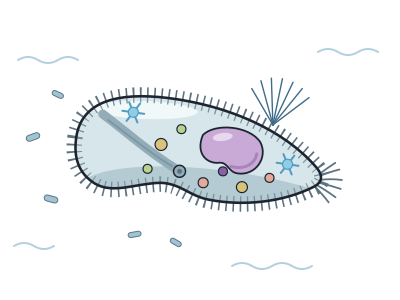
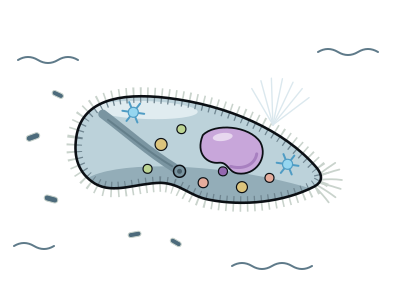
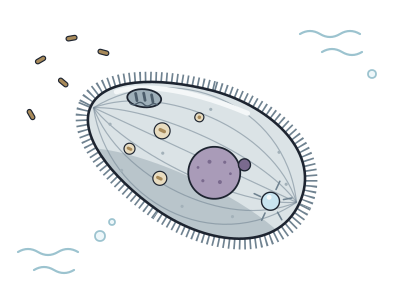
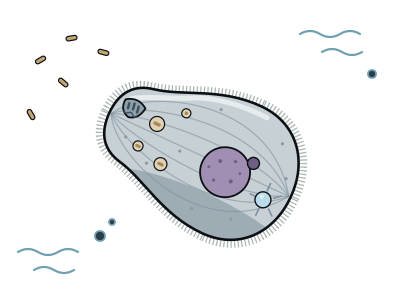
Picture a living slipper about a quarter of a millimetre long, rowing through pond water with thousands of tiny hairs. The whole creature is just one cell. Its hairs, called cilia, beat in rippling waves, like wind moving across a wheat field. They push it along at about a millimetre a second, which is several of its own body lengths every second. It travels on a corkscrew path, spinning as it goes.
Just under its surface sit thousands of tiny carrot-shaped harpoons called trichocysts. When a hunter attacks, the paramecium fires a burst of them from the spot that was hit. Each one shoots out in less than a thousandth of a second and grows about eight times longer. The threads are not poisonous. They may push the attacker away, and the recoil helps the paramecium escape.
It is not an animal or a plant. It belongs to the ciliates, a group of hairy single cells that also includes the trumpet animalcule and the bell animalcule. Surprisingly, ciliates are grouped with dinoflagellates and with the group that includes the malaria parasite. That means this harmless pond-dweller is more closely related to the malaria parasite than to us.
It lives in still fresh water all over the world. Hairs lining a groove on its side sweep bacteria, yeast and small algae into a mouth-like opening.
Bump, back up, try again
It has no eyes. When it bumps into something, it flips the direction its hairs beat, backs up, turns a little and tries again. An electrical signal much like a nerve signal sets off this move, so scientists have called it a 'swimming neuron'.
Two control centres
It has two nuclei. A large one runs the cell's everyday life, and a small one is used for reproduction.
Bubbles as sour as vinegar
Its food is wrapped in tiny bubbles that drift around the cell. In about five minutes, the inside of each bubble becomes roughly as acidic as vinegar, which helps break the food down.
Next to it on the tree
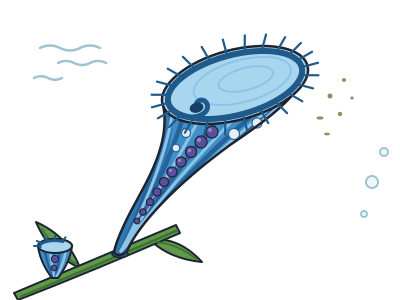
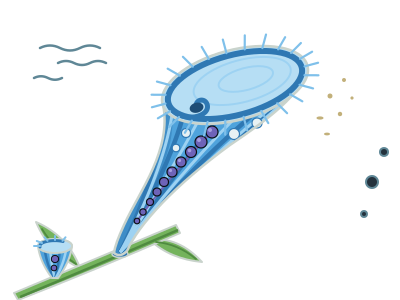
- Trumpet animalculeA blue, trumpet-shaped single cell big enough to see by eye, and able to regrow from a fragment.
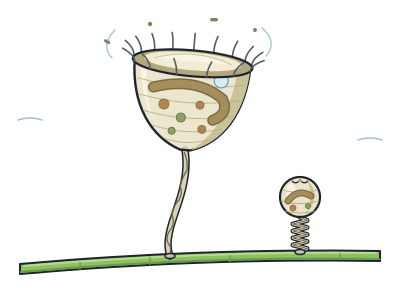
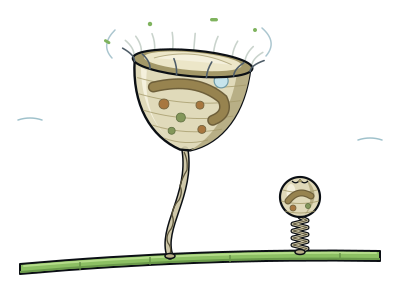
- Bell animalculeA bell on a spring-loaded stalk that snaps shut faster than almost anything alive.
- TetrahymenaA pond ciliate behind two Nobel Prizes: chromosome tips and RNA that acts like an enzyme.
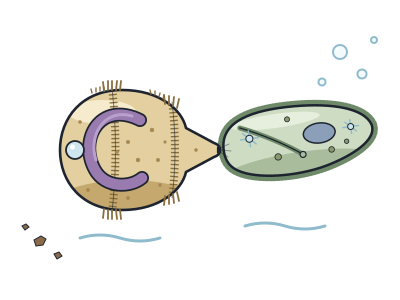
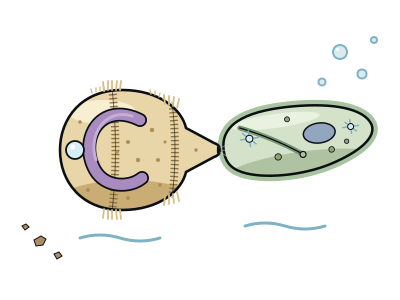
- Barrel ciliateA barrel-shaped hunter that swallows Paramecium whole, prey nearly as big as itself.
- Walking ciliateInstead of swimming, it strolls on tufts of fused hairs that work like little legs.