A species
Trumpet animalcule
Stentor coeruleus
A blue trumpet made of just one cell, which can rebuild itself from a small piece
You and the trumpet animalcule meet in the Eukaryotes branch, shown at about 1.8 billion years ago (on 28 July, in a calendar from life's shared ancestor to today).
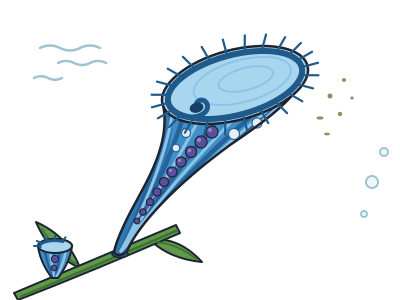
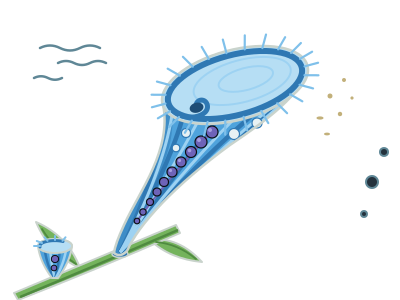
Look closely at pond weed and you might spot a tiny blue speck. That speck is one single cell, about 1 millimetre long, roughly the size of a grain of sand. Most cells are far too small to see without a microscope, but this one is a giant. When it settles, it stretches into a long blue trumpet, stuck to a surface by a sticky narrow end.
Despite the old name 'animalcule', it is not an animal. It is a ciliate, a single cell covered in tiny beating hairs called cilia. On the tree of life, ciliates sit with kelp, diatoms and the parasite that causes malaria, a long way from animals. Even among ciliates, it is only a distant relative of Paramecium and Tetrahymena.
Its most famous trick is regrowing. Cut it in half and each half can rebuild a complete, normally shaped cell, as long as each piece keeps part of its large control centre, which looks like a string of beads. Even a small fragment, if it is not too tiny, can rebuild a whole cell within hours.
At the wide end of the trumpet, a spiral band of thousands of cilia stirs up a whirlpool. This sweeps bacteria, smaller ciliates and bits of debris into its mouth.
Faster than a blink
When disturbed, it snaps from a trumpet into a little droplet in just thousandths of a second. That is more than ten thousand times faster than its other changes of shape.
Learning without a brain
It can learn to ignore harmless taps that keep happening, even though it has no brain or nerves.
Named after a loud voice
It was first described in 1744. In 1815 its group was named after Stentor, a herald in Greek myth with a booming voice, because the cell looks like a speaking trumpet.
Next to it on the tree
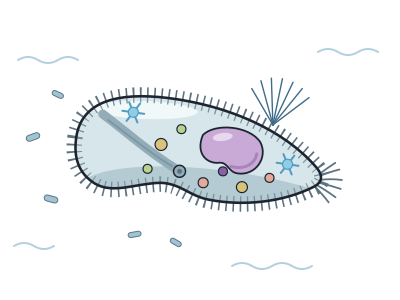
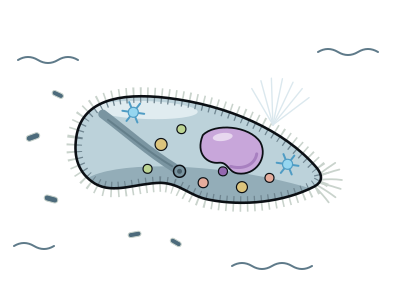
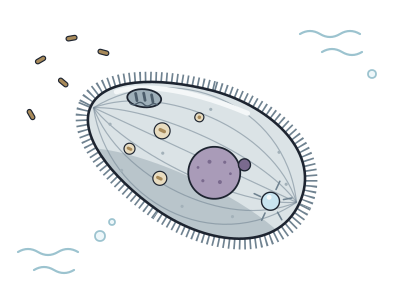
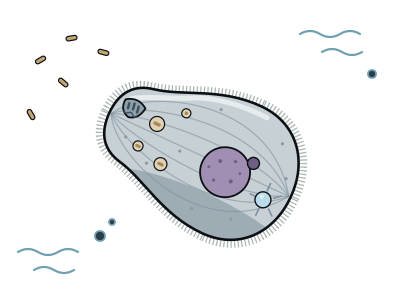
- ParameciumA slipper-shaped cell that rows with hairs and fires tiny harpoons when threatened.
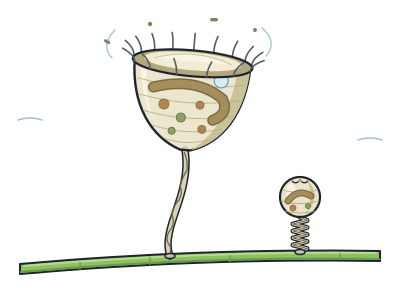
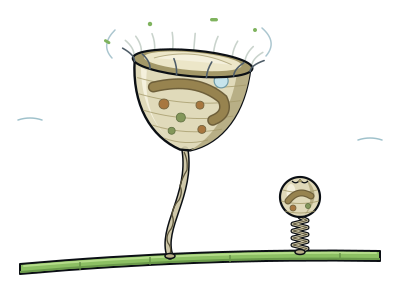
- Bell animalculeA bell on a spring-loaded stalk that snaps shut faster than almost anything alive.
- TetrahymenaA pond ciliate behind two Nobel Prizes: chromosome tips and RNA that acts like an enzyme.
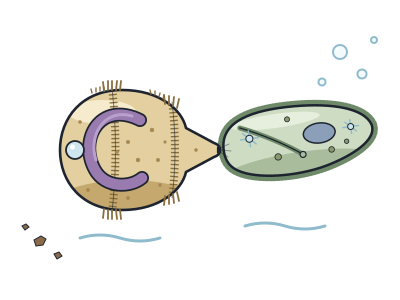
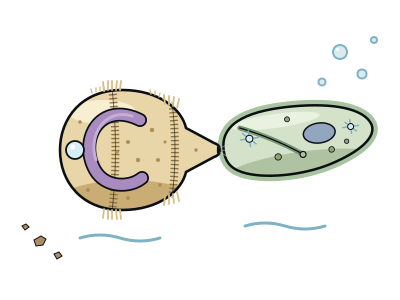
- Barrel ciliateA barrel-shaped hunter that swallows Paramecium whole, prey nearly as big as itself.
- Walking ciliateInstead of swimming, it strolls on tufts of fused hairs that work like little legs.