A species
Walking ciliate
Euplotes patella
A single cell that walks across the pond floor on tiny tufted "legs".
You and the walking ciliate meet in the Eukaryotes branch, shown at about 1.8 billion years ago (on 28 July, in a calendar from life's shared ancestor to today).
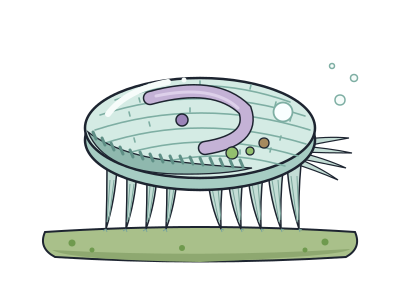
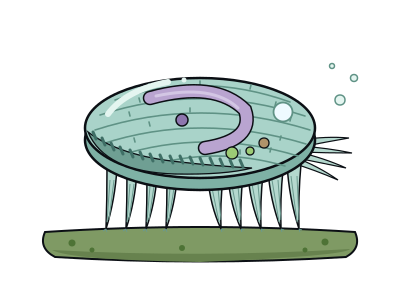
Plenty of single cells drift or swim. This one walks. On its underside are stiff tufts, and each one is a bundle of many tiny hairs stuck together. It uses them like little legs to step over sunken bits of leaf, water plants and the bottom of the pond. It can swim too, but it likes to settle on surfaces.
It is a ciliate, a relative of the Paramecium, which swims freely through pond water. Ciliates sit on the same branch of the tree as dinoflagellates and the malaria parasite. So this little walker is closer to them than to any animal, even though it walks like a tiny bug.
The whole creature is one cell about a tenth of a millimetre long. It has no nerves and no brain. Yet studies of its close relatives show they move their 'legs' in set patterns, helped by fibres inside the cell. They can even do a quick side-step: a dart backwards, then a turn. Each side-step goes with a quick change in the electrical charge across the cell's outer surface.
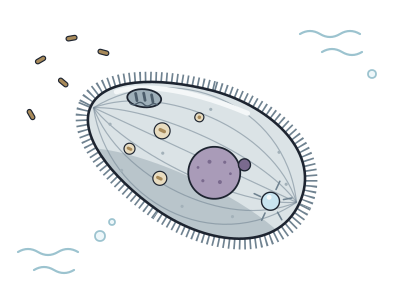
Its body is a stiff, clear oval, flattened like a small dish. A curving fringe of beating hairs runs along a huge mouth groove and sweeps food inside.
Two kinds of nucleus
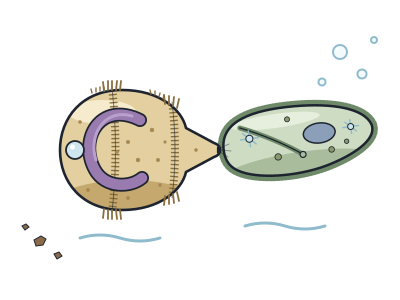
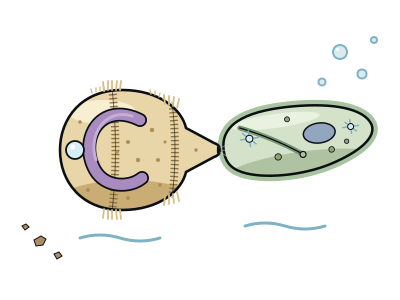
Like other ciliates, it has two kinds of nucleus. Its big one is a long C-shaped band, and a small round one sits separately beside it.
Relatives in sea urchins
Its relatives live in the sea, fresh water, soil and moss. Two species even live harmlessly inside the guts of sea urchins.
Spotted long ago
A naturalist first recorded members of its group in 1773, and the group got its name in 1830. By 1975, more than 80 kinds had been described.
Next to it on the tree
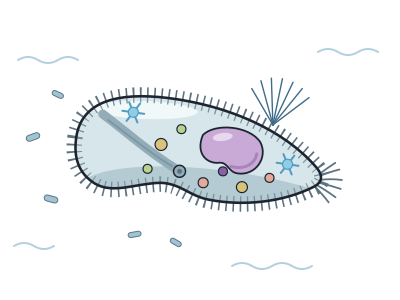
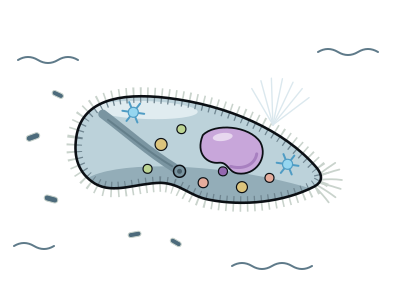
- ParameciumA slipper-shaped cell that rows with hairs and fires tiny harpoons when threatened.
- Trumpet animalculeA blue, trumpet-shaped single cell big enough to see by eye, and able to regrow from a fragment.
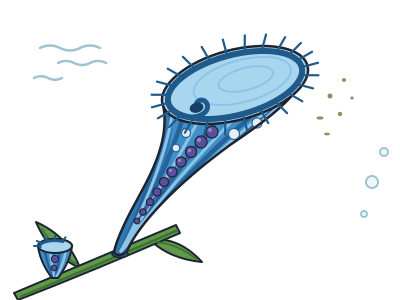
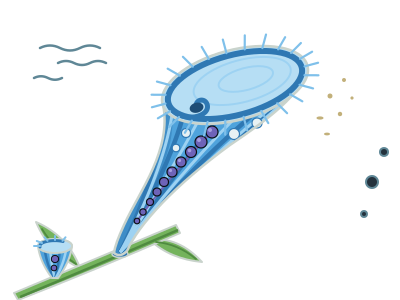
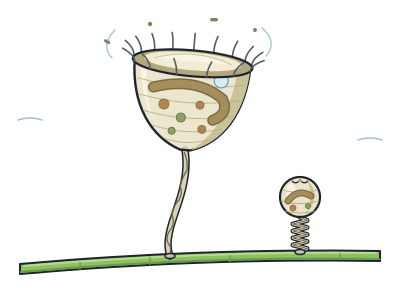
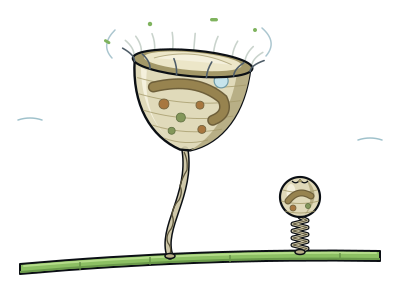
- Bell animalculeA bell on a spring-loaded stalk that snaps shut faster than almost anything alive.
- TetrahymenaA pond ciliate behind two Nobel Prizes: chromosome tips and RNA that acts like an enzyme.
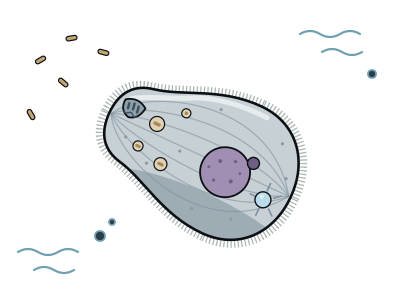
- Barrel ciliateA barrel-shaped hunter that swallows Paramecium whole, prey nearly as big as itself.