A species
Bell animalcule
Vorticella convallaria
A tiny bell on a coiled spring that snaps shut in a few thousandths of a second
You and the bell animalcule meet in the Eukaryotes branch, shown at about 1.8 billion years ago (on 28 July, in a calendar from life's shared ancestor to today).
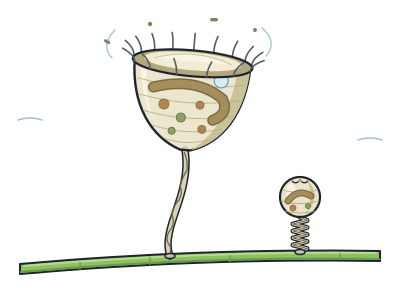
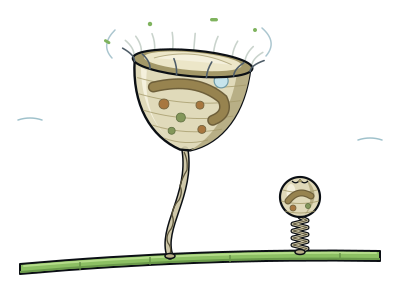
Picture a see-through bell sitting on a thread-thin stalk, stuck to a bit of pond weed. Disturb it, and the stalk coils into a tight corkscrew spring in just a few thousandths of a second, shrinking to about a fifth of its length. The bell closes up into a ball. Then, slowly, the stalk uncoils and the bell opens again.
The spring is a fibre that winds in a spiral inside the stalk. Most of the tiny motors inside cells creep along at a few millionths of a metre per second. This one moves at centimetres per second and pulls about a thousand times harder. Gram for gram, it is more powerful than human muscle or a car engine. It doesn't work like muscle, either. Calcium is its trigger: a rush of calcium makes it snap shut, and when the calcium is cleared away it slowly stretches out again.
Despite its old name, which means 'little animal', it is not an animal at all. It is a single cell, a ciliate, and a relative of Paramecium and the trumpet animalcule. Bands of beating hairs around the bell's rim stir up a current that sweeps bacteria into its mouth area.
First seen in 1676
Antonie van Leeuwenhoek described it in a letter in 1676. He thought it had two moving 'horns' like a horse's ears, but they were really its beating feeding hairs.
Named after whirlpools
Its name comes from the Latin word for whirlpool, because its beating hairs whip up tiny swirling currents in the water.
One stays, one swims off
It mostly reproduces by splitting in two. One half keeps the old stalk. The other grows a ring of hairs at its back end, swims away, settles somewhere new and grows its own stalk.
Next to it on the tree
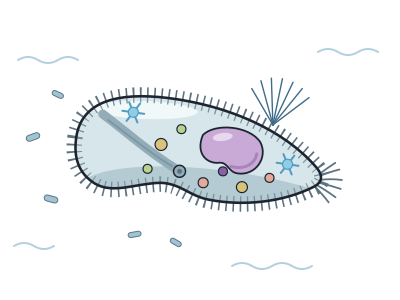
- ParameciumA slipper-shaped cell that rows with hairs and fires tiny harpoons when threatened.
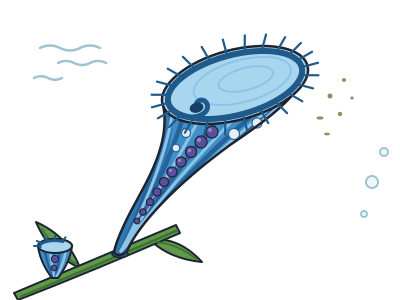
- Trumpet animalculeA blue, trumpet-shaped single cell big enough to see by eye, and able to regrow from a fragment.
- TetrahymenaA pond ciliate behind two Nobel Prizes: chromosome tips and RNA that acts like an enzyme.
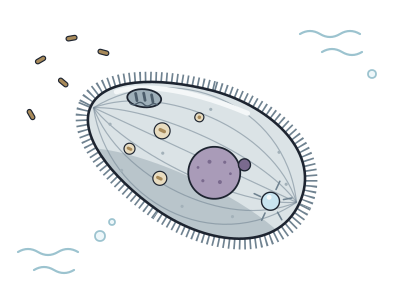
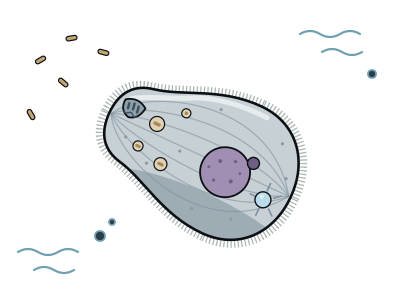
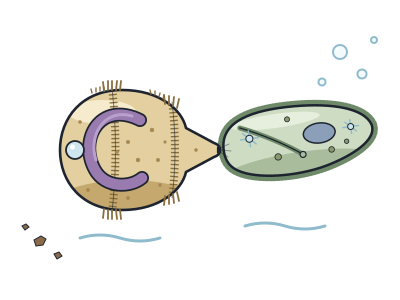
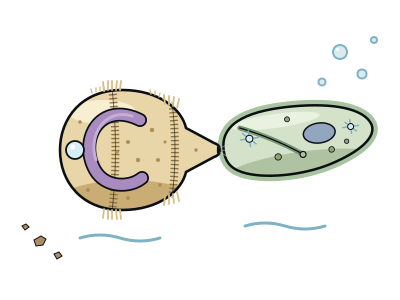
- Barrel ciliateA barrel-shaped hunter that swallows Paramecium whole, prey nearly as big as itself.
- Walking ciliateInstead of swimming, it strolls on tufts of fused hairs that work like little legs.