An extinct species
Amber malaria parasite †
Plasmodium dominicana
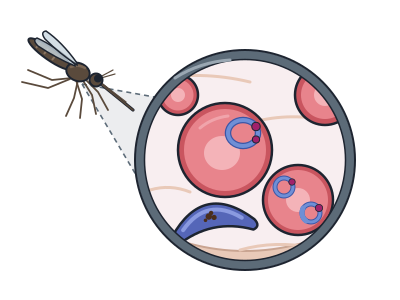
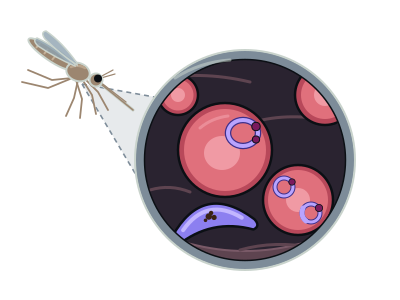
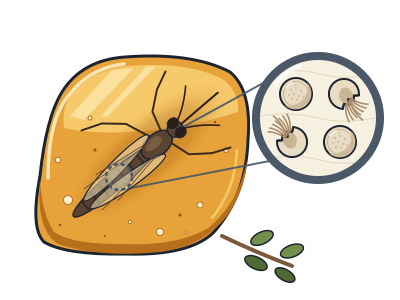
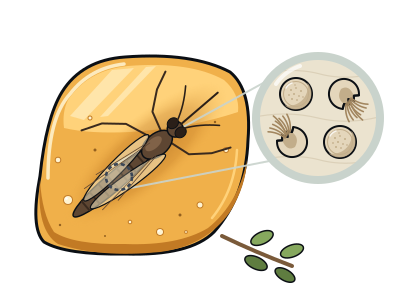
Malaria parasites sealed inside a mosquito trapped in amber
Lived about 20–15 million years ago.
You and the amber malaria parasite meet in the Eukaryotes branch, shown at about 1.8 billion years ago (on 28 July, in a calendar from life's shared ancestor to today).
About 20 to 15 million years ago, a female mosquito in a tropical forest got stuck in sticky tree resin. The resin hardened into amber and sealed her inside. Millions of years later, scientists looked closely and found something much smaller hidden in her body: malaria parasites. It is described as the oldest known fossil from the same group as the malaria parasites that infect people today.
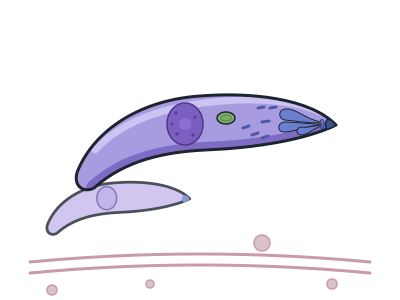
Each parasite was a single cell, far too small to see without a microscope. The mosquito held four round cysts, each about as wide as a human hair, and two of them had burst open. Thin, thread-like cells lay around them and in her spit glands. A mosquito passes on that stage when it bites, so she could probably have spread the infection.
The fossil shows only the shapes of these cells. Everything else is worked out from clues. Scientists think the parasite probably lived in a bird, perhaps one from the chicken and quail group. One clue is that this kind of mosquito carries bird malaria today. Humans did not exist yet.
Its living relatives include the parasite behind the deadliest kind of human malaria, and another parasite called Toxoplasma. Both carry a tiny leftover part from an alga that one of their ancestors swallowed long ago.
The mosquito got a name too
Scientists named the infected mosquito as a new extinct species, Culex malariager. They called it the first fossil mosquito known to carry this kind of malaria parasite. Both the mosquito and the parasite were described in 2005 by George Poinar Jr.
Dug from a Dominican mine
The amber came from the La Toca mine in the Dominican Republic, between the cities of Puerto Plata and Santiago. Only three of the mosquito's six legs are still attached: both front legs and one middle leg.
An older malaria-like cousin
An even older malaria-like parasite has been reported inside a biting midge in amber about 100 million years old, from the age of the dinosaurs. It belongs to a different, more ancestral group, not to the malaria parasite group itself.