A species
Toxoplasma
Toxoplasma gondii
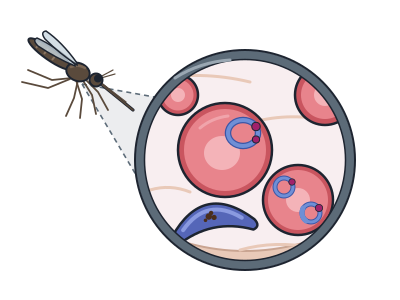
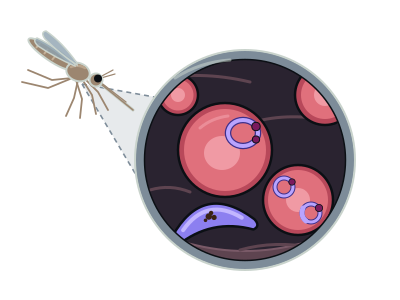
A tiny parasite that breeds only in cats and makes mice stop fearing the smell of cats.
You and the toxoplasma meet in the Eukaryotes branch, shown at about 1.8 billion years ago (on 28 July, in a calendar from life's shared ancestor to today).
This tiny parasite can live inside almost any warm-blooded animal, from birds to people. But in nature it can only breed, mixing its genes the way living things do in sex, inside members of the cat family, from house cats to bobcats and leopards. Everywhere else it just copies itself by splitting. Cats seem to be special because their guts lack a tool for changing a certain fatty acid from their food. So that fatty acid builds up in their guts, and it sets off the parasite's breeding stage.
Its strangest effect shows up in mice. In experiments, infected mice lost their normal fear of the smell of cat urine. Their reaction to rabbit urine, a smell from a harmless animal, did not change. Scientists are still working out why this happens.
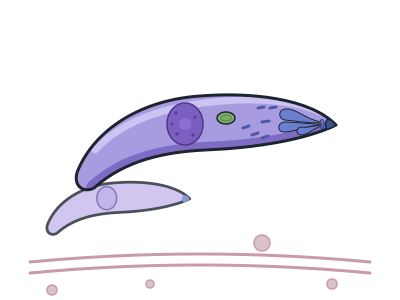
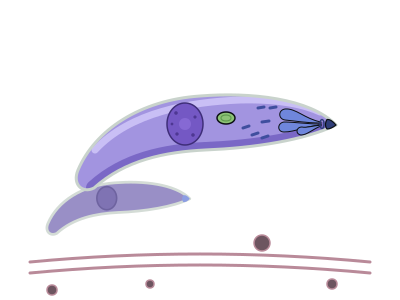
Each parasite is a single cell shaped like a tiny banana. It is far too small to see: about 10 to 20 of them end to end would only just cross the width of a human hair. It belongs to the same group as the malaria parasites. Both carry a small leftover part that came from a swallowed red alga and is related to the parts plants use to catch sunlight. It can no longer make food from light, but the parasite still needs it to survive.
Roughly a third of people worldwide have been infected. Most healthy people never feel ill, but it can be serious for unborn babies and for people with weak immune systems.
Named after a rodent
In 1908, two scientists working in Tunis, in North Africa, found it and named it after the gundi, a small rodent they found it in.
Fresh droppings aren't infectious yet
The tough 'eggs' that cats pass in their droppings need about 1 to 5 days in soil or water before they can infect anything.
The fearlessness lasts
In one study, infected mice stayed unafraid of cat smell for at least four months. With a weakened strain, the fearlessness lasted even after the parasite had been cleared from their bodies.