A species
Baobab
Adansonia digitata
A fat-trunked African tree that stores water and can live for over 2,000 years
You and the baobab meet in the Eukaryotes branch, shown at about 1.8 billion years ago (on 28 July, in a calendar from life's shared ancestor to today).
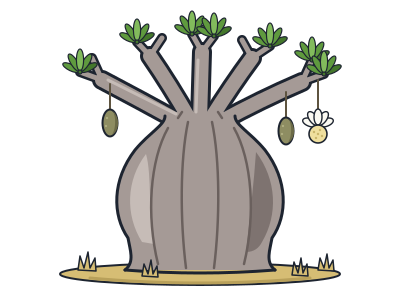
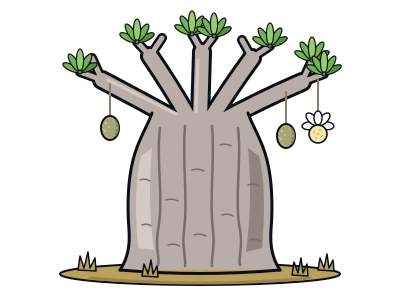
Picture a tree with a trunk so fat that the biggest ones are about 10 to 14 metres across. That is about as wide as a bus is long. The trunk is also a water store, and a large tree may hold well over 100,000 litres. Baobabs can live for a very long time, too. Some in Africa have lived for more than 2,000 years. The Panke baobab in Zimbabwe was about 2,450 years old when it died in 2011. That makes it the oldest flowering plant ever reliably dated.
Scientists cannot count rings to find a baobab's age, because these trees do not grow clear yearly rings. They use radiocarbon dating instead.
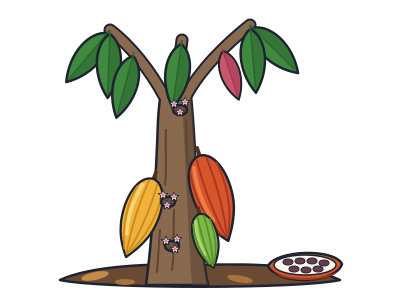
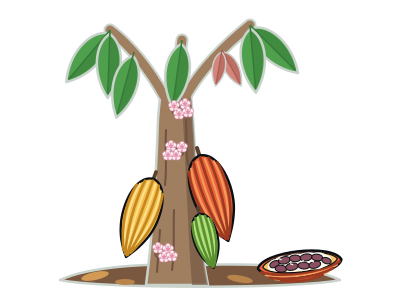
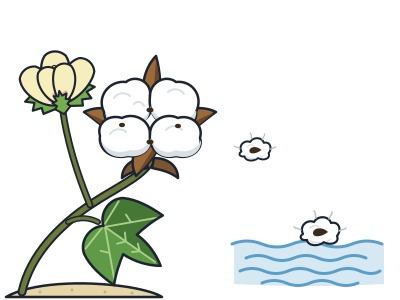
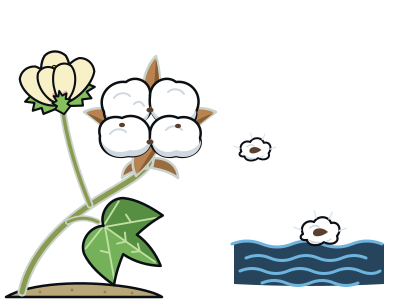
Surprisingly, this giant is a relative of the cacao tree and the cotton plant. All three belong to the mallow family. Its closest living relatives are trees that grow in tropical America.
It grows in hot, dry savannas south of the Sahara. For most of the dry season it stands bare, and its stubby branches look like roots. That is why people call it the 'upside-down tree'. Its stored water lets it start growing its first new leaves before the rains arrive. Simple leaves come first, then leaves with two or three leaflets, and finally hand-shaped ones with five to seven leaflets spread like fingers.
One-night flowers
Its large white flowers open in the late afternoon or evening and last just one night. Each holds from several hundred to about 2,000 stamens, and fruit bats are the main pollinators.
A Madagascan family
There are eight kinds of baobab. Six grow only in Madagascar, one grows in north-western Australia, and this is the only one on mainland Africa.
A tree of many uses
People make rope, baskets and cloth from the bark fibre and eat the leaves as a vegetable. Hollow trunks have been used to store water and have even sheltered people.