Explore a little deeper
Humans
Meet ancient human relatives through fossils, reconstructions and the questions they leave behind. Follow the story of one living species with many journeys.
See humans on the tree of life →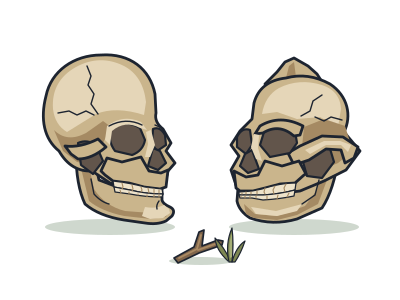
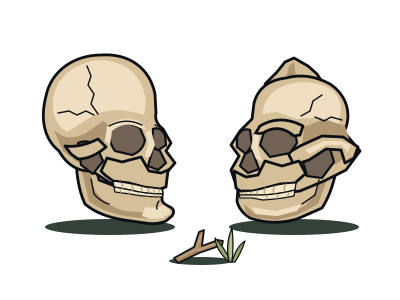
Dashed branches show browsing or study group membership. They do not establish direct ancestry or a date of divergence.
Drag to move. Pinch or ctrl/⌘-scroll to zoom. Use arrow keys on a card to reach every entry. Click a card for a closer look.
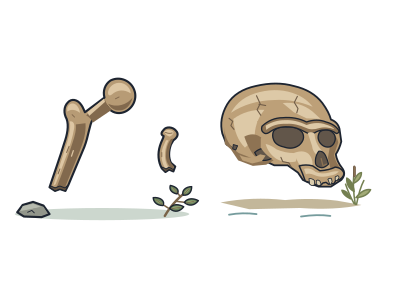
Browse every entry as a list
This diagram groups fossils for exploration. An edge is not proof of direct ancestry; fossil dates are known occurrence ranges, not exact origin, extinction or divergence dates. Reconstructions are interpretations.
One species, many journeys
About 300,000 years ago · African origins
Our species emerged in Africa. Its origins involved populations and places across time, rather than a single person or moment.
Before 100,000 years ago · Early journeys
Fossils record early movements beyond Africa. A jaw from Misliya Cave in present-day Israel was assigned to Homo sapiens and dated to about 177,000–194,000 years ago. A fossil records presence at a place, not the date of a single departure or a complete migration route.
About 51,000–44,000 years ago · Ancient encounters
A 2024 genetic study places a major period of Neanderthal ancestry entering Homo sapiens in this approximate interval. Other evidence records encounters with Denisovans. Early journeys and later expansions need not have left the same descendants; a branching diagram cannot show every connection.
Continuing to today · A connected humanity
People settled across regions, and movement and connections continued. Every living person belongs to Homo sapiens; geographic ancestry is not a set of separate human species or a ranking.
Context: Smithsonian: Homo sapiens fossil evidence; Hershkovitz et al. (2018): Misliya fossil; Iasi et al. (2024): Neanderthal ancestry through time; Smithsonian: One Species, Living Worldwide; Ancient DNA and Neanderthals. These are selected evidence milestones, not population split dates. Routes, dates and contributions of particular migrations remain subjects of research.
Sources and interpretation
This diagram groups fossils for exploration. An edge is not proof of direct ancestry; fossil dates are known occurrence ranges, not exact origin, extinction or divergence dates. Reconstructions are interpretations.
- Smithsonian Human Origins: species and human variation · Linked for factual reference; no source imagery reused.
Independently written factual summaries and links only; no museum prose, drawings, photos, 3D models or family-tree graphic imported.
Selected facts and group membership adapted; simplified layout and original illustrations by Lifetree.