An extinct species
Homo erectus †
Homo erectus
A human relative pieced together from ancient bones
Known fossil occurrence: about 2–0.11 million years ago.
This diagram groups fossils for exploration. An edge is not proof of direct ancestry; fossil dates are known occurrence ranges, not exact origin, extinction or divergence dates. Reconstructions are interpretations. Older summaries start near 1.89 million years ago; Drimolen fossils assigned to Homo erectus extend the evidence to about 2 million years ago. Taxonomic assignments and first/last occurrences remain uncertain.
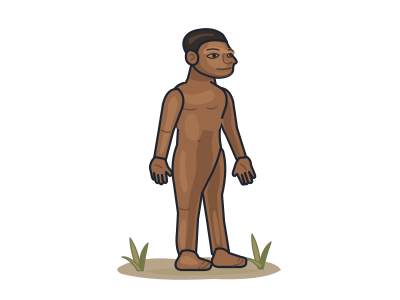
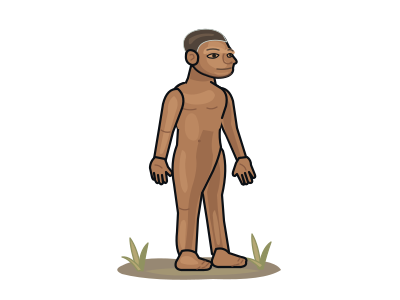
Return to the tree of life →This extinct member of our human family had a surprisingly familiar body. Early African individuals had relatively long legs and short arms, with proportions closer to ours than those of earlier human relatives. Reported fossils extended from about two million to 110,000 years ago, including early finds at Drimolen in South Africa. Those dates marked known fossil evidence, not an exact beginning or end for the species.
Skulls showed a long, low head, a large face and a strong ridge above the eyes. The jaw lacked a projecting chin. Fossils assigned to this species came from Africa, Georgia, China and Indonesia. It was among the earliest humans known to spread beyond Africa.
These humans did not live alone in the human family. In East Africa, they overlapped with other human relatives. Early handaxes—stone tools shaped on both sides—appeared about 1.76 million years ago and were often linked with this species. Such finds offered clues to daily life, rather than a complete picture.
A defining discovery
A skullcap found in Java in 1891 became the official reference fossil used to define the species.
Lost fossils, surviving copies
Most early Peking Man fossils disappeared in 1941, but accurate replicas had already been made.
A varied menu
Evidence from Chinese sites indicated that these humans ate both meat and plant foods.
Study attribution
Smithsonian Human Origins: species and human variation. Independently written factual summaries and links only; no museum prose, drawings, photos, 3D models or family-tree graphic imported.
Selected facts/group membership adapted; simplified layout and illustrations by Lifetree.