An extinct species
Homo rudolfensis †
Homo rudolfensis
A human relative pieced together from fossils.
Known fossil occurrence: about 2.1–1.8 million years ago.
This rounded range includes older fossil-age constraints from a 2013 study, about 2.06–1.95 million years, alongside the Smithsonian’s 1.9–1.8 million-year summary. Species assignments and the complete fossil range remain debated. These are evidence dates, not exact origins, extinctions or splits; branches do not prove direct ancestry.
Return to the tree of life →This extinct human relative belonged to our wider family, but was not a proven direct ancestor. Its story came mainly from skulls, jaws and teeth, rather than complete skeletons. The Smithsonian summarised its known fossil record as about 1.9 to 1.8 million years ago. These were dates of fossil occurrences, not exact dates when the species began or disappeared.
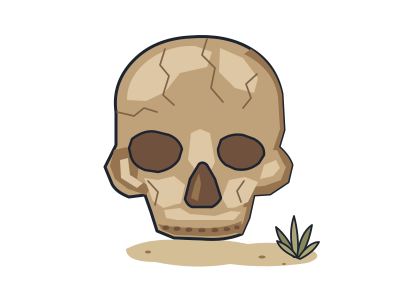
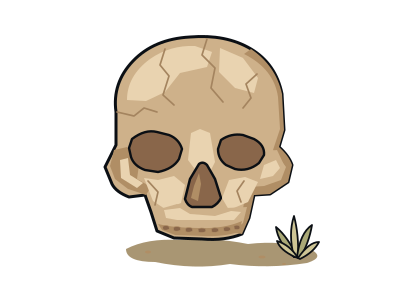
The best-known skull, from northern Kenya, was reconstructed from more than 150 fragments. It showed a long, broad face and a large space for the brain for an early human. Its missing teeth and lower jaw meant that a complete-looking reconstruction went beyond what that individual preserved.
A second fossil face resembled the first, strengthening the evidence that this face shape was not unique to one individual. It retained almost all its upper back teeth, helping researchers work out which lower-jaw shape would fit. Even with these discoveries, the fossils did not provide reliable estimates of height or weight.
A named discoverer
Bernard Ngeneo discovered the best-known skull, KNM-ER 1470, at Koobi Fora in Kenya in 1972.
A lake behind the name
The species was named in 1986 after Lake Rudolf, now called Lake Turkana.
Not a single-file procession
It was one of four early human species recognised in the Turkana Basin during the broader interval about 2 to 1.5 million years ago.
Study attribution
Smithsonian Human Origins: species and human variation. Independently written factual summaries and links only; no museum prose, drawings, photos, 3D models or family-tree graphic imported.
Selected facts/group membership adapted; simplified layout and illustrations by Lifetree.