An extinct species
Homo habilis †
Homo habilis
An early human relative, not a proven direct ancestor
Known fossil occurrence: about 2.4–1.4 million years ago.
This diagram groups fossils for exploration. An edge is not proof of direct ancestry; fossil dates are known occurrence ranges, not exact origin, extinction or divergence dates. Reconstructions are interpretations.
Return to the tree of life →This early human relative was usually placed in the same human group as us, but its exact relationship to us remained uncertain. Its known fossils dated from about 2.4 to 1.4 million years ago. It lived in Africa and overlapped with Homo erectus in eastern Africa. The story was not simply one species disappearing before another appeared.
Bones showed a mixture of features. Its skull suggested a somewhat larger brain, and its face and teeth were smaller, than those of earlier relatives called australopiths. Leg and foot bones supported upright walking. Its finger bones were slightly curved, while their proportions suggested it could hold small objects precisely.
Chipped stones and sharp flakes found in association with this relative could have helped cut food. But these finds did not prove it invented stone tools: tools about 3.3 million years old were older than its known fossils. Wear on its teeth suggested a varied diet that included plant foods and some animal food.
A handy name
The species was named in 1964. Its name meant ‘handy’ or ‘skilful’ human.
Small skull, grown adult
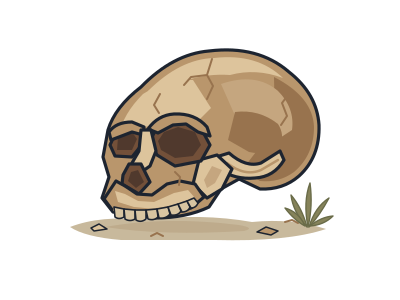
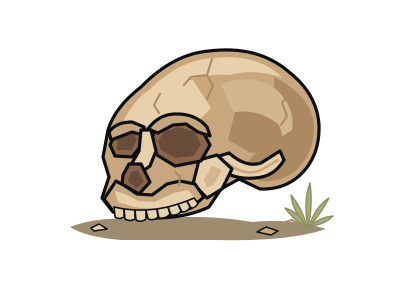
The skull KNM-ER 1813 held about half a litre inside its braincase. Its worn wisdom teeth showed that it belonged to an adult.
Hundreds of pieces
The partial skeleton OH 62 was recovered as about 300 fragments of fossilised teeth and bones.
Study attribution
Smithsonian Human Origins: species and human variation. Independently written factual summaries and links only; no museum prose, drawings, photos, 3D models or family-tree graphic imported.
Selected facts/group membership adapted; simplified layout and illustrations by Lifetree.