An extinct species
Homo heidelbergensis †
Homo heidelbergensis
A human story pieced together from bones
Known fossil occurrence: about 700,000–200,000 years ago.
This diagram groups fossils for exploration. An edge is not proof of direct ancestry; fossil dates are known occurrence ranges, not exact origin, extinction or divergence dates. Reconstructions are interpretations.
Return to the tree of life →These extinct human relatives belonged to our wider human family. Fossils assigned to this group dated from about 700,000 to 200,000 years ago and came from Europe and Africa. Their story was pieced together from jaws, teeth, skulls and limb bones.
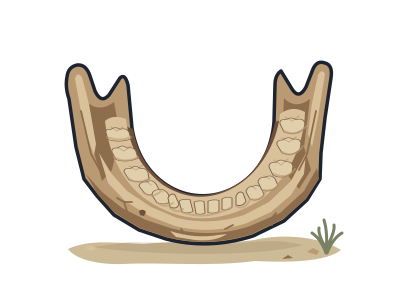
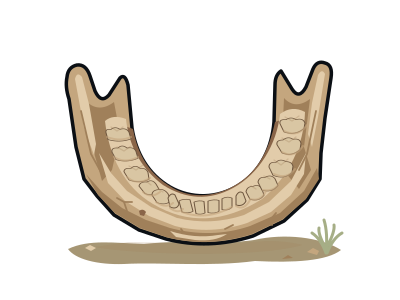
A nearly complete lower jaw from Mauer, Germany, became the specimen used to name the species in 1908. It was strongly built and had no projecting chin. The Kabwe skull combined a low skull roof and large ridges above the eyes with a flatter face that resembled ours.
Their stone tools included handaxes shaped by chipping flakes from both sides. Cut marks on large-animal bones at associated sites showed that animals were cut up for food. These marks were direct evidence of food preparation; hunting was an interpretation of the wider evidence.
A worker’s discovery
Sand-pit worker Daniel Hartmann discovered the Mauer jaw in 1907.
An ancient tooth problem
Ten upper teeth in the Kabwe skull had cavities, showing that this individual experienced tooth decay.
A powerful leg
A thick shinbone from Boxgrove, England, had strong ridges where muscles attached, suggesting a powerful build for that individual.
Study attribution
Smithsonian Human Origins: species and human variation. Independently written factual summaries and links only; no museum prose, drawings, photos, 3D models or family-tree graphic imported.
Selected facts/group membership adapted; simplified layout and illustrations by Lifetree.