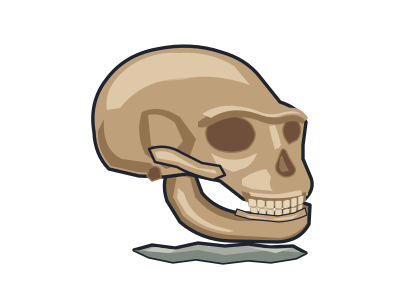
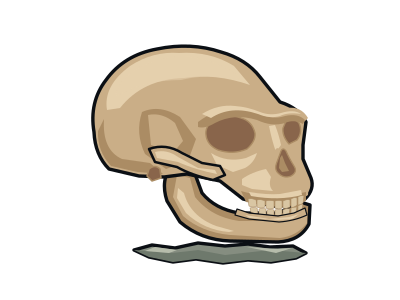
An extinct species
Homo naledi †
Homo naledi
A human relative with a surprising mixture of features
Known fossil occurrence: about 335,000–236,000 years ago.
This diagram groups fossils for exploration. An edge is not proof of direct ancestry; fossil dates are known occurrence ranges, not exact origin, extinction or divergence dates. Reconstructions are interpretations.
Return to the tree of life →This extinct human relative had a surprising mixture of features. Its shoulders and hips resembled those of earlier human relatives, while its hands and feet looked more like ours. Yet those similarities did not establish it as our direct ancestor. Its exact place in the human family remains unresolved.
It lived about 335,000 to 236,000 years ago, judging from dated fossils found in South Africa’s Rising Star cave system. These were the ages of known remains, not exact dates for when the species first appeared or disappeared. Finding its bones underground did not establish that it normally lived in caves.
Its hand bones showed a sturdy thumb and wrist suited to strong, precise grips. Long, curved finger bones also suggested that climbing and hanging were important activities. These were clues from anatomy, not preserved records of behaviour. Likewise, a line joining species in this diagram is a browsing link, not proof that one was the other’s ancestor.
A recent discovery
The fossils were discovered in 2013, and the species was formally named in 2015.
Many individuals
Early work in Dinaledi Chamber recovered more than 1,550 fossil pieces from at least 15 individuals.
A name from the stars
The word “naledi” meant “star” in Sotho, referring to the Rising Star cave system.
Study attribution
Smithsonian Human Origins: species and human variation. Independently written factual summaries and links only; no museum prose, drawings, photos, 3D models or family-tree graphic imported.
Selected facts/group membership adapted; simplified layout and illustrations by Lifetree.