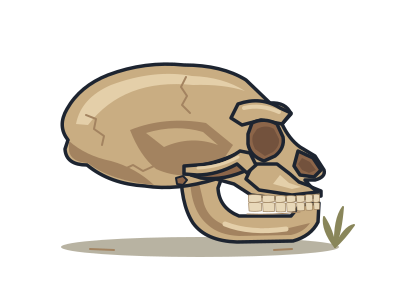
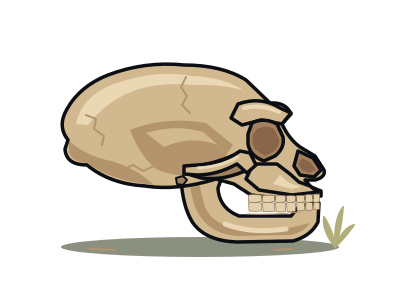
An extinct species
Homo neanderthalensis †
Homo neanderthalensis
Close human relatives, known through bones and DNA
Known fossil occurrence: about 400,000–40,000 years ago.
This diagram groups fossils for exploration. An edge is not proof of direct ancestry; fossil dates are known occurrence ranges, not exact origin, extinction or divergence dates. Reconstructions are interpretations.
Return to the tree of life →Neanderthals were among our closest extinct human relatives, not steps on a simple ladder leading to us. Their known fossils dated from about 400,000 to 40,000 years ago. Those finds do not give exact dates for when the species arose or disappeared. This diagram groups fossils for exploration; its lines do not prove direct ancestry.
Their remains included skulls, teeth, scattered bones and several nearly complete skeletons. These gave scientists much more evidence than a handful of fragments. Neanderthals lived across Europe and parts of Asia, in cold grasslands as well as warmer woodlands. They were not confined to landscapes beside ice sheets.
They hunted large animals, while some coastal groups also ate shellfish and other sea foods. They made carefully shaped stone tools by preparing a larger stone before striking flakes from it. They also had children with members of our species. Many people today carry about 2% Neanderthal DNA, though the amount varies.
Brain size was not an intelligence test
Their brains were comparable in size to ours and often larger. Size alone did not establish intelligence.
The familiar stoop was a mistake
The old hunched reconstruction arose partly from interpreting a skeleton that showed joint disease.
Named after a valley
The species was named in 1864 after Germany’s Neander Valley, where an important partial skeleton had been found in 1856.
Study attribution
Smithsonian Human Origins: species and human variation. Independently written factual summaries and links only; no museum prose, drawings, photos, 3D models or family-tree graphic imported.
Selected facts/group membership adapted; simplified layout and illustrations by Lifetree.