An extinct species
Paranthropus boisei †
Paranthropus boisei
A broad-faced relative on a different human branch
Known fossil occurrence: about 2.3–1.2 million years ago.
This diagram groups fossils for exploration. An edge is not proof of direct ancestry; fossil dates are known occurrence ranges, not exact origin, extinction or divergence dates. Reconstructions are interpretations.
Return to the tree of life →This extinct human relative belonged to a side branch of our family, rather than a species generally regarded as our direct ancestor. Its known fossils dated from about 2.3 to 1.2 million years ago. It lived in eastern Africa alongside early members of our own human group: our family had several branches living at overlapping times.
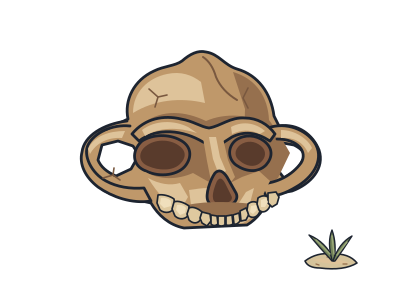
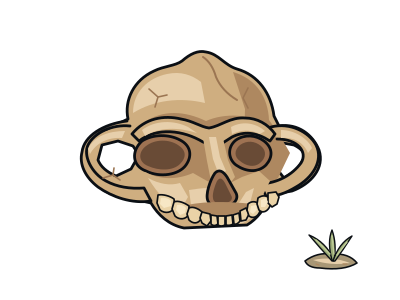
Skulls and teeth preserved its most striking features. Wide cheekbones gave its face a broad, dish-shaped outline. Its front teeth were small beside enormous grinding teeth. Some back teeth had about four times the chewing surface area of ours. A bony ridge on large male skulls provided an anchor for chewing muscles; the skull's shape suggested powerful chewing.
Yet big teeth did not tell the whole food story. Chemical evidence in the teeth pointed to a diet dominated by foods from tropical grasses or sedges, grass-like plants often found in wet places. The evidence challenged the familiar image of a nut specialist. Its exact menu remained uncertain: tooth chemistry could not reveal precisely which plant parts it ate.
A landmark discovery
Mary Leakey discovered the nearly complete skull called OH 5 at Olduvai Gorge, Tanzania, in 1959. It was about 1.8 million years old.
The reference fossil
OH 5 became the type specimen—the official fossil reference for the species. No lower jaw was found with it.
A name of thanks
The species name honoured Charles Boise, who helped fund Louis Leakey's fossil-searching expeditions.
Study attribution
Smithsonian Human Origins: species and human variation. Independently written factual summaries and links only; no museum prose, drawings, photos, 3D models or family-tree graphic imported.
Selected facts/group membership adapted; simplified layout and illustrations by Lifetree.