An extinct species
Paranthropus robustus †
Paranthropus robustus
Big grinding teeth, uncertain family ties.
Known fossil occurrence: about 2–1.2 million years ago.
This diagram groups fossils for exploration. An edge is not proof of direct ancestry; fossil dates are known occurrence ranges, not exact origin, extinction or divergence dates. Reconstructions are interpretations. Drimolen specimens extend the known record to about 2 million years ago, older than the 1.8-million-year start in some summaries.
Return to the tree of life →This extinct relative belonged to our wider human family, but was generally regarded as a side branch rather than a direct ancestor of living people. Its fossils came from South Africa and dated to about 2 to 1.2 million years ago. The two species shown beside it were known from eastern Africa.
“Robust” described its strongly built chewing equipment, not a giant body. Its large back teeth had thick enamel, the hard outer covering, and broad surfaces for grinding food. These fossil teeth showed what its mouth could handle, but did not reveal every meal.
It probably ate a varied diet, including softer foods, rather than only hard nuts and seeds. Fossils were found in cave deposits, but that alone did not show that it normally lived in caves.
A ridge for chewing muscles
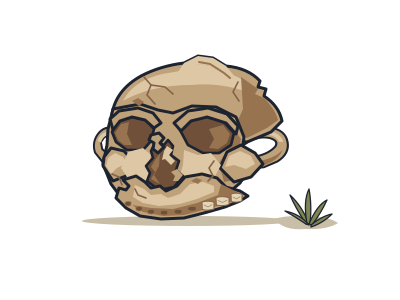
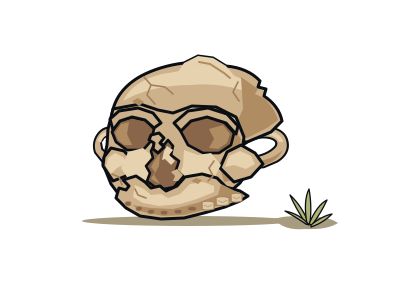
Some skulls had a bony ridge along the top, providing attachment space for powerful chewing muscles.
A remarkable skull
The fossil nicknamed Eurydice was discovered at Drimolen in 1994. It preserved much of the skull and a lower jaw.
A schoolboy helped
In 1938, schoolboy Gert Terblanche helped bring the original Kromdraai fossils to scientific attention. Robert Broom recognised and named the species.
Study attribution
Smithsonian Human Origins: species and human variation. Independently written factual summaries and links only; no museum prose, drawings, photos, 3D models or family-tree graphic imported.
Selected facts/group membership adapted; simplified layout and illustrations by Lifetree.