An extinct species
Paranthropus aethiopicus †
Paranthropus aethiopicus
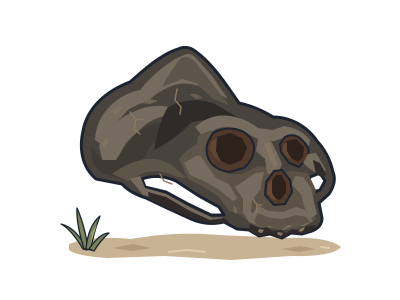
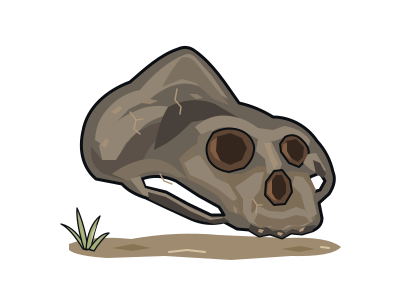
A human relative known mainly through its remarkable skull
Known fossil occurrence: about 2.7–2.3 million years ago.
This diagram groups fossils for exploration. An edge is not proof of direct ancestry; fossil dates are known occurrence ranges, not exact origin, extinction or divergence dates. Reconstructions are interpretations.
Return to the tree of life →This extinct member of our human family was a relative, not a proven direct ancestor. Its known fossils dated from about 2.7 to 2.3 million years ago. It was grouped with two other Paranthropus species, whose strong jaws and large back teeth earned them the nickname ‘robusts’. Their neighbouring positions in this diagram do not establish ancestor-to-descendant relationships.
Fossils were found in eastern Africa, including northern Kenya and southern Ethiopia. The famous ‘Black Skull’ preserved a nearly complete braincase and face, but no lower jaw or body. Its face projected strongly forwards, its cheekbones spread widely, and a tall bony ridge ran along its crown. That ridge suggested it had powerful chewing muscles. Surviving tooth roots indicated that it once had very large back teeth.
Yet the picture remained incomplete. Very few remains were known, and no bones from below the skull were securely assigned to this species. Its teeth and skull offered clues about chewing, but they did not reveal an exact menu.
Blackened underground
The Black Skull became dark through mineral absorption during fossilisation in manganese-rich soil. Its colour was not evidence of dark skin or hair.
A different reference fossil
The species’ official reference fossil was Omo 18, an incomplete toothless lower jaw—not the famous Black Skull.
A small braincase
The Black Skull’s braincase held about 410 cubic centimetres: a little over 400 millilitres.
Study attribution
Smithsonian Human Origins: species and human variation. Independently written factual summaries and links only; no museum prose, drawings, photos, 3D models or family-tree graphic imported.
Selected facts/group membership adapted; simplified layout and illustrations by Lifetree.