An extinct species
Australopithecus garhi †
Australopithecus garhi
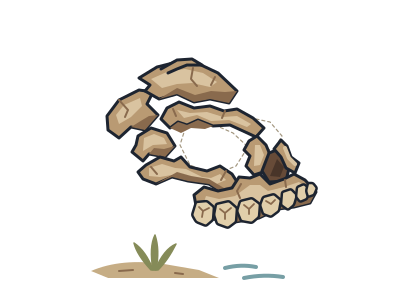
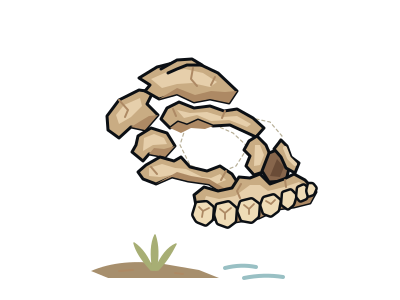
A fragmentary skull from our human family
Known fossil occurrence: about 2.5 million years ago.
This diagram groups fossils for exploration. An edge is not proof of direct ancestry; fossil dates are known occurrence ranges, not exact origin, extinction or divergence dates. Reconstructions are interpretations.
Return to the tree of life →This extinct member of our human family lived about 2.5 million years ago. Its fossils offered clues to its appearance, not proof that it was our direct ancestor. This diagram groups fossils for exploration: a connecting line does not establish direct ancestry.
The fossils came from Bouri in Ethiopia. The defining find preserved parts of the front and sides of the skull, an upper jaw and upper teeth—not a whole head or body. Its lower face projected forwards, unlike the flatter face of living humans. Its back teeth were very large, with a thick outer coating called enamel.
The surrounding sediments and animal fossils pointed to a lakeside landscape. They suggested grassy plains with grazing antelope beside a freshwater lake. Volcanic ash beneath the fossils helped researchers work out their age. Other animal fossils and ancient magnetic signals provided separate checks on that date.
A surprising name
The name garhi meant ‘surprise’ in the Afar language.
Discovery and announcement
Yohannes Haile-Selassie discovered the defining partial skull in 1997. The species was announced in 1999.
A ridge for chewing
A ridge along the top of the skull provided attachment points for large chewing muscles.
Study attribution
Smithsonian Human Origins: species and human variation. Independently written factual summaries and links only; no museum prose, drawings, photos, 3D models or family-tree graphic imported.
Selected facts/group membership adapted; simplified layout and illustrations by Lifetree.