An extinct species
Australopithecus africanus †
Australopithecus africanus
An upright human relative with a climber’s build
Known fossil occurrence: about 3.3–2.1 million years ago.
The displayed 3.3–2.1 million-year range follows the Smithsonian summary. Some Sterkfontein sediment studies report older ages, around 3.4–3.6 million years, while other methods give younger estimates. Dating and fossil attribution remain debated. Branches are browsing groups, not proven ancestry; reconstructions are interpretations.
Return to the tree of life →Fossil bones revealed a surprising combination in this early member of our human family: upright walking and a body still suited to climbing. It lived in South Africa about 3.3 to 2.1 million years ago, according to the fossil range shown here. Finds came from places including Taung, Sterkfontein and Makapansgat.
Hip, thigh and foot bones provided evidence of walking on two legs. Shoulder and hand bones also showed features suited to climbing. Long arms, curved finger and toe bones, and a projecting lower face completed a mixture unlike our own. These clues supported a picture of how it moved, rather than a record of its daily routine.
Tooth wear suggested a varied diet that included softer plant foods, not just hard objects. Its reconstructed surroundings included woodland mixed with open grassland. Although cave deposits preserved many remains, finding bones in caves did not establish that these relatives routinely lived inside them.
Less than half a litre
Its estimated brain volume averaged about 480 cubic centimetres—slightly less than half a litre.
A cast, not a brain
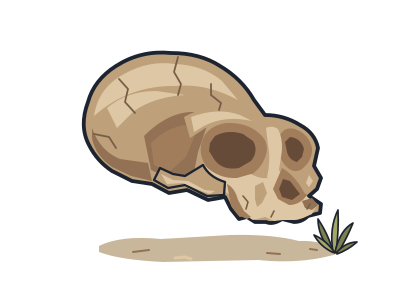
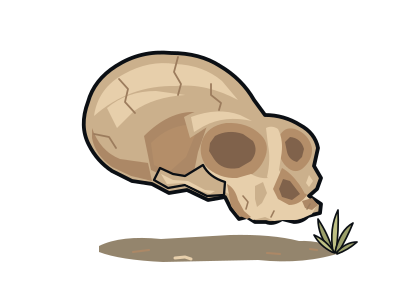
The Taung Child preserved a partial skull and a natural cast of the space inside its braincase, not the brain itself. It was the fossil used as the standard when the species was named.
Predators helped gather the bones
Animal bones found alongside its fossils once inspired a misleading picture of a violent hunting ape. Later work showed that predators helped accumulate the remains.
Study attribution
Smithsonian Human Origins: species and human variation. Independently written factual summaries and links only; no museum prose, drawings, photos, 3D models or family-tree graphic imported.
Selected facts/group membership adapted; simplified layout and illustrations by Lifetree.