An extinct species
Australopithecus afarensis †
Australopithecus afarensis
An upright walker with a small brain—and an uncertain place in our family story.
Known fossil occurrence: about 3.85–2.95 million years ago.
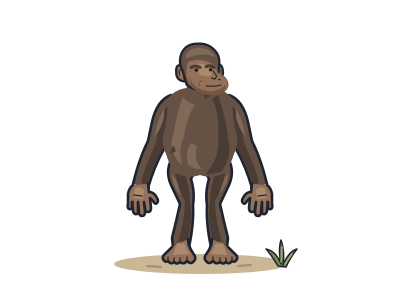
This diagram groups fossils for exploration. An edge is not proof of direct ancestry; fossil dates are known occurrence ranges, not exact origin, extinction or divergence dates. Reconstructions are interpretations.
Return to the tree of life →This early human relative regularly walked upright, yet its brain was roughly a third the size of ours. Its fossils helped show that two-legged walking evolved before large human brains. Known fossils dated from about 3.85 to 2.95 million years ago and came from what are now Ethiopia, Kenya and Tanzania.
Bones provided clues to how it moved. Its short, broad hip bones and angled thigh bones were evidence of upright walking. Long arms and curved finger bones suggested that it could also climb trees. Fossil sites suggested varied surroundings, including grassland, woodland and denser forest near lakes, rather than one uniform grassland home.
Lucy was one individual from this species. Her partial skeleton, discovered in Ethiopia in 1974, was about 3.2 million years old and about 40% complete. Although she stood only about a metre tall, her teeth and fused bones showed that she was a young adult. Such remains revealed anatomy, but did not establish a proven chain of ancestors leading to us.
More than Lucy
Researchers recovered remains attributed to more than 300 individuals.
A jaw set the reference
The species’ official reference fossil was LH 4, a lower jaw found in Tanzania in 1974—not Lucy.
Clues from tooth wear
Tiny wear marks on its teeth suggested that it ate soft plant foods, including fruit.
Study attribution
Smithsonian Human Origins: species and human variation. Independently written factual summaries and links only; no museum prose, drawings, photos, 3D models or family-tree graphic imported.
Selected facts/group membership adapted; simplified layout and illustrations by Lifetree.