An extinct species
Australopithecus sediba †
Australopithecus sediba
A human relative with a surprising mix of features
Known fossil occurrence: about 1.98 million years ago.
The known Malapa fossils date to about 1.98 million years ago. Their age does not establish the species’ full lifespan or exact origin, extinction or split dates. Branches are browsing groups, not proven ancestry; reconstructions are interpretations.
Return to the tree of life →This human relative combined a small brain and long arms with some teeth and hip features resembling those of our own human group. That surprising mixture did not establish it as a direct ancestor of living people. Its exact relationship to us remained uncertain.
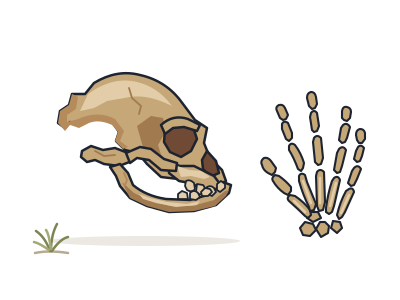
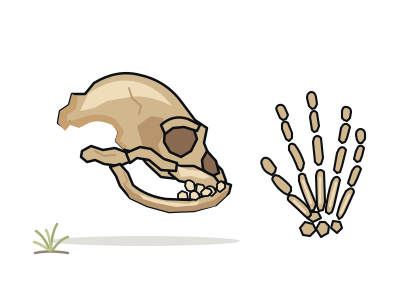
Its known fossils dated to about 1.98 million years ago, in what is now South Africa. All known fossils came from Malapa, near Johannesburg. Most detailed knowledge came from two partial skeletons, not complete bodies. Bones and teeth preserved clues to its build, but did not reveal its full appearance.
Its hip bones suggested that it regularly walked upright, while other bones suggested climbing abilities. Exactly how it moved remained an interpretation. In this diagram, connecting lines group fossils for exploration; they do not prove direct ancestry. Likewise, a lifelike reconstruction is an interpretation, not a preserved record of skin or hair.
A child's discovery
Nine-year-old Matthew Berger found the first recognised fossil, a collarbone, at Malapa in August 2008.
A new name in 2010
Researchers announced it as a new species in April 2010, less than two years after the first discovery.
A name meaning wellspring
The second part of its name meant ‘fountain’ or ‘wellspring’ in Sesotho.
Study attribution
Smithsonian Human Origins: species and human variation. Independently written factual summaries and links only; no museum prose, drawings, photos, 3D models or family-tree graphic imported.
Selected facts/group membership adapted; simplified layout and illustrations by Lifetree.