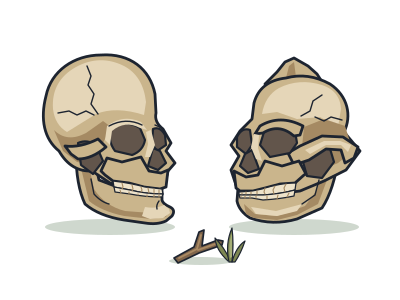
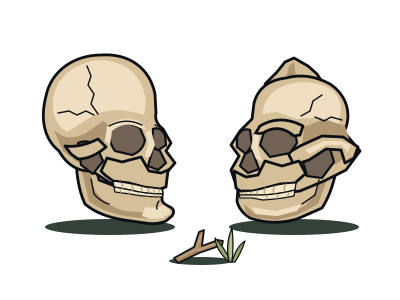
An exploration group
Our human family
Hominins
A branching family, not a ladder of progress.
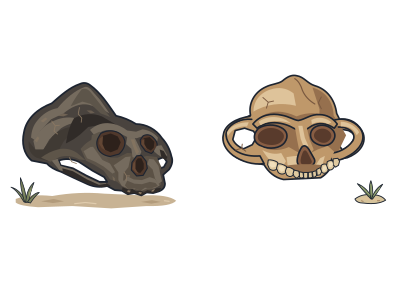
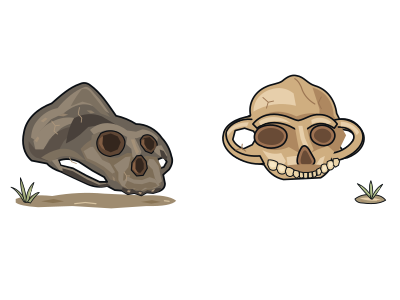
This diagram groups fossils for exploration. An edge is not proof of direct ancestry; fossil dates are known occurrence ranges, not exact origin, extinction or divergence dates. Reconstructions are interpretations.
Return to the tree of life →Our human family is a branching story, not a ladder of progress. It includes living people and extinct human relatives, rather than a single species. Different early human species sometimes shared the same region at the same time. Today, all living people belong to one species, Homo sapiens.
Explore this diagram as a guide to that wider family, not a settled chain of ancestors. Its browsing groups organise fossils. A connecting line does not prove that one species was another’s direct ancestor. The date ranges describe the ages of fossils found so far, not exactly when a species began, disappeared or split into separate branches.
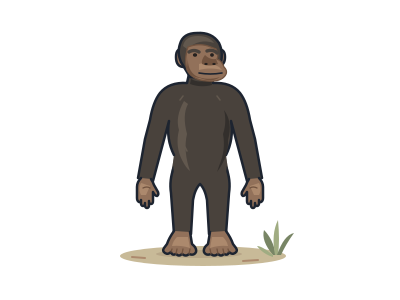
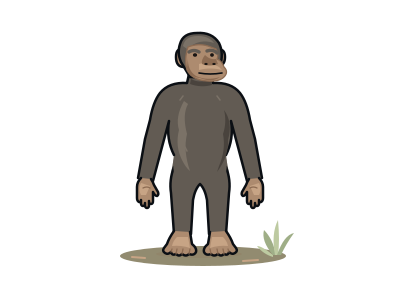
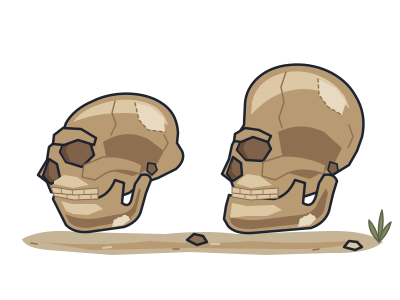
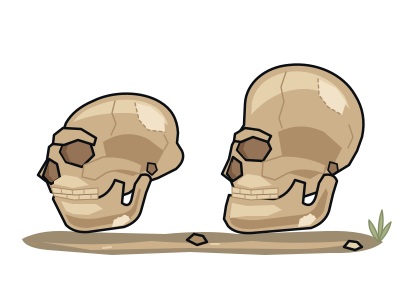
Scientists piece this story together from incomplete evidence. Reconstructed faces and bodies are interpretations, not exact pictures of how those individuals looked in life. They help us imagine our relatives, but cannot settle every detail of their appearance or behaviour.
Walking came first
Walking on two legs developed before the large brains characteristic of living humans. Our familiar features did not all appear together.
More than bones
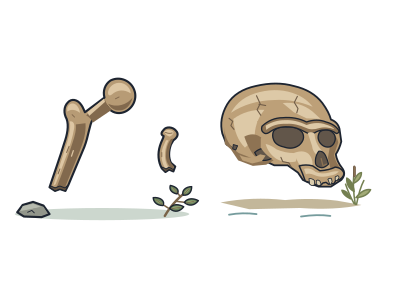
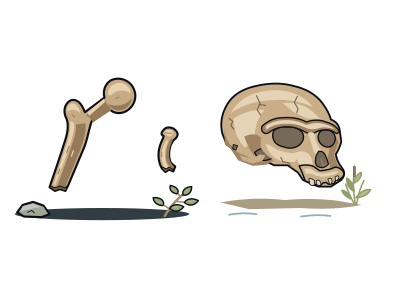
Footprints, tools and other traces of activities provide evidence alongside fossil bones and teeth.
Extinct, with a genetic legacy
An extinct population can still leave inherited DNA in living people. Neanderthal ancestry is one example.
Explore this group
Study attribution
Smithsonian Human Origins: species and human variation. Independently written factual summaries and links only; no museum prose, drawings, photos, 3D models or family-tree graphic imported.
Selected facts/group membership adapted; simplified layout and illustrations by Lifetree.