An extinct species
Ardipithecus kadabba †
Ardipithecus kadabba
Scattered fossils, an unfinished family story.
Known fossil occurrence: about 5.8–5.2 million years ago.
This diagram groups fossils for exploration. An edge is not proof of direct ancestry; fossil dates are known occurrence ranges, not exact origin, extinction or divergence dates. Reconstructions are interpretations.
Return to the tree of life →This early human relative was known from scattered teeth and bones, not a complete skeleton. It belonged in the story of our human family, but its exact relationships remained unresolved. Its fossils came from Ethiopia’s Middle Awash region and dated to about 5.8 to 5.2 million years ago.
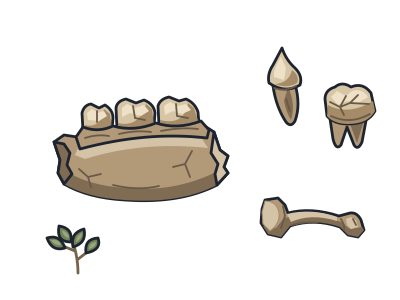
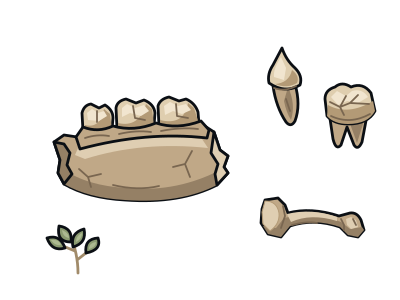
Its teeth showed a mixture of features. Its canines—the pointed teeth near the front—projected beyond the tooth row, unlike the short canines in living humans. Compared with chimpanzees, it had larger back teeth for chewing and narrower front teeth for cutting. These surviving pieces offered clearer evidence than any imagined face or coat of hair.
Fossils found alongside its remains suggested woodland and grassland near lakes, swamps and springs. That setting contrasted with the dry, rocky landscape where researchers later searched. A living reconstruction could help us picture this relative, but it would remain an interpretation, not a portrait preserved in stone.
A jaw started the search
Yohannes Haile-Selassie found the first recognised specimen, a lower-jaw fragment, in 1997.
Several individuals
The original collection contained 11 specimens from at least five individuals.
A changed classification
Scientists first described it as a subspecies of Ardipithecus ramidus in 2001, then recognised it as a separate species in 2004.
Study attribution
Smithsonian Human Origins: species and human variation. Independently written factual summaries and links only; no museum prose, drawings, photos, 3D models or family-tree graphic imported.
Selected facts/group membership adapted; simplified layout and illustrations by Lifetree.