An extinct species
Ardipithecus ramidus †
Ardipithecus ramidus
An early human relative with a branch-gripping big toe
Known fossil occurrence: about 4.4 million years ago.
This diagram groups fossils for exploration. An edge is not proof of direct ancestry; fossil dates are known occurrence ranges, not exact origin, extinction or divergence dates. Reconstructions are interpretations.
Return to the tree of life →This early member of our human family had feet very unlike ours. Its big toe pointed away from the other toes and could grip branches, rather than pointing forwards like ours. It lived about 4.4 million years ago. Its fossils came from Ethiopia, in eastern Africa.
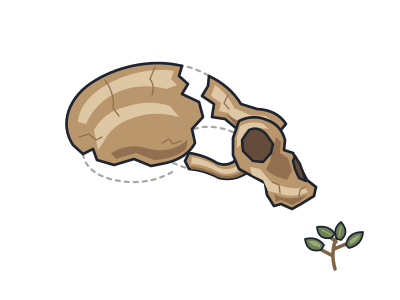
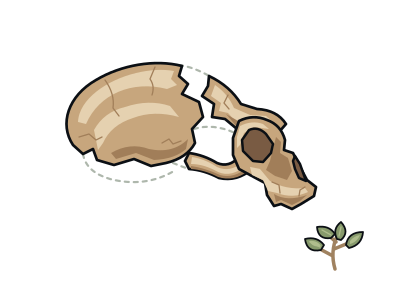
Much of what researchers learned came from a partial skeleton nicknamed Ardi. The preserved bones included long, curved fingers that would have helped with grasping branches. Her skull suggested a brain within the size range of living chimpanzees. The bones were extremely fragile, and researchers used detailed scans to help piece the damaged remains together.
Researchers interpreted the reconstructed hip bones as evidence of both climbing and walking on two legs. That did not establish a modern human stride. The links in this diagram grouped fossils for exploration, rather than identifying a proven chain of direct ancestors.
A species defined by teeth
The specimen that formally defined the species consisted of teeth and jaw bone found at Aramis in 1993.
A name with roots
The name combined Afar words meaning ground or floor and root with a Greek-derived word for ape.
Years of careful study
Ardi’s detailed scientific description appeared in 2009, about 15 years after the skeleton’s discovery.
Study attribution
Smithsonian Human Origins: species and human variation. Independently written factual summaries and links only; no museum prose, drawings, photos, 3D models or family-tree graphic imported.
Selected facts/group membership adapted; simplified layout and illustrations by Lifetree.