An extinct species
Sahelanthropus tchadensis †
Sahelanthropus tchadensis
An ancient skull and an open family question
Known fossil occurrence: about 7–6 million years ago.
This diagram groups fossils for exploration. An edge is not proof of direct ancestry; fossil dates are known occurrence ranges, not exact origin, extinction or divergence dates. Reconstructions are interpretations.
Return to the tree of life →This ancient ape may have been an early member of our human family, but its place remained debated. It lived about 7 to 6 million years ago, judging by the known fossils. The diagram groups fossils for exploration; a connecting line does not prove that one species was another’s ancestor.
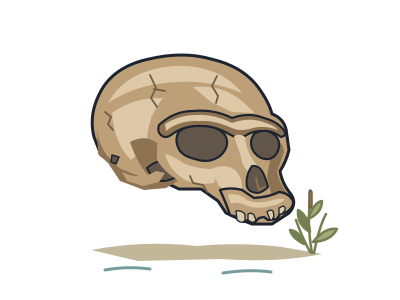
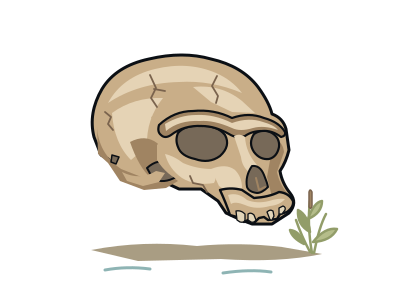
The best-known fossil was a nearly complete skull, nicknamed Toumaï. It had been flattened and distorted, so scientists had to account for that damage when rebuilding its shape. The skull had a small braincase and heavy ridges above the eyes. Its face was flatter than those of living African apes, but stuck out farther than ours.
Other fossils from the area included fish, crocodiles, hippopotamuses, giraffes, elephants and antelopes. These remains helped researchers piece together its ancient surroundings. They suggested a landscape with lakes, rivers, forest and wooded grassland, very different from the desert there today.
A discovery in 2001
A team led by Michel Brunet discovered the famous skull at Toros-Menalla in Chad in 2001.
Hope of life
The nickname Toumaï meant ‘hope of life’ in the local Dazaga language.
No confirmed tools
There was no confirmed evidence that this species used tools.
Study attribution
Smithsonian Human Origins: species and human variation. Independently written factual summaries and links only; no museum prose, drawings, photos, 3D models or family-tree graphic imported.
Selected facts/group membership adapted; simplified layout and illustrations by Lifetree.