A species
Homo sapiens
Homo sapiens
Our own branch of the great ape family
This diagram groups fossils for exploration. An edge is not proof of direct ancestry; fossil dates are known occurrence ranges, not exact origin, extinction or divergence dates. Reconstructions are interpretations.
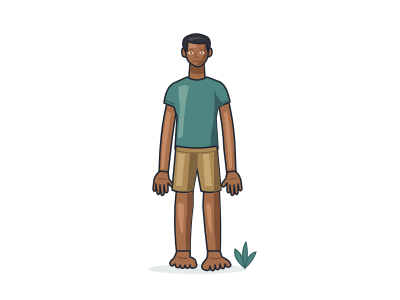
Return to the tree of life →The fossils on this branch tell our own family’s story. We are great apes, but we did not descend from any ape species living today. Everyone alive today belongs to one human species, however different we look. Ours is the only human species still living.
Our species originated in Africa. The Smithsonian lists its range as about 300,000 years ago to today—not an exact birthday. Fossils preserve evidence such as bones and teeth, sometimes much more than tiny scraps. The Cro-Magnon 1 skull, found in France in 1868, is complete apart from its teeth.
Living people typically have a high, rounded skull, a small face and a chin that sticks out. These features did not all appear together in our ancient relatives, which makes the earliest members of our species difficult to identify. Prehistoric people also left evidence of art, music and ornaments.
This diagram groups fossils for exploration. Neighbouring branches are not a proven ladder leading to us, and a connecting line does not establish direct ancestry.
Tools for particular jobs
Prehistoric people made fishhooks, harpoons and sewing needles.
Farming came much later
Farming and animal herding developed within roughly the past 12,000 years.
A lighter build
Compared with many earlier humans, our species generally has a lighter skeleton, smaller teeth and less heavily built jaws.
Study attribution
Smithsonian Human Origins: species and human variation. Independently written factual summaries and links only; no museum prose, drawings, photos, 3D models or family-tree graphic imported.
Selected facts/group membership adapted; simplified layout and illustrations by Lifetree.