A species
Superb bird-of-paradise
Lophorina superba
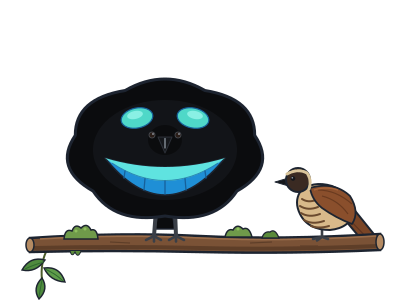
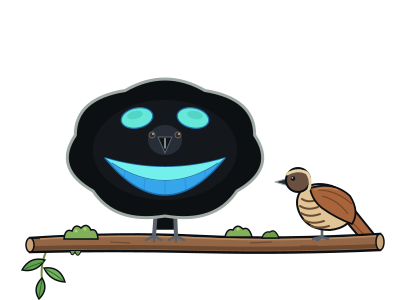
A black-caped dancer that turns itself into a glowing blue smiley face.
You and the superb bird-of-paradise meet in the Amniotes branch, shown at about 320 million years ago (on 4 December, in a calendar from life's shared ancestor to today).
When a female comes near, the male superb bird-of-paradise changes shape. He flips a cape of black feathers up and forward into a wide oval around his head. He pushes a shiny blue breast shield up into a curved 'smile', and two bright spots near his crown look like eyes. From the front he no longer looks like a bird. He looks like a black disc with an electric-blue smiley face, bouncing as he hops in circles around her.
That cape is one of the blackest things in nature. It reflects only about 0.05 to 0.31% of light shone straight onto it, up to about 100 times less than ordinary black feathers. The trick is mostly feather shape, not just pigment. Tiny spiky branches on each feather bounce light around until it is trapped. His ordinary back feathers are shinier, which suggests the super-black evolved for showing off.
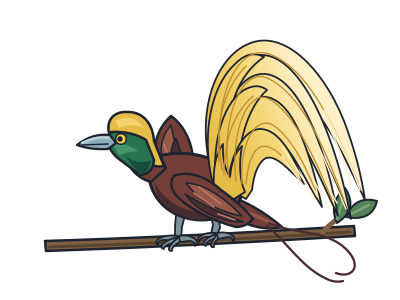
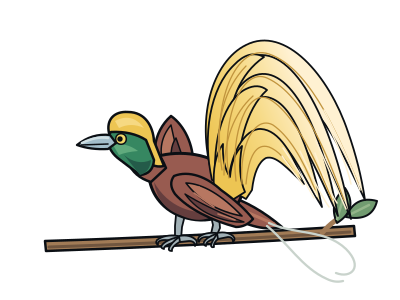
For all its fancy dress, this bird is a relative of crows. It is a songbird in the crow group. Its neighbour on the tree, the greater bird-of-paradise, is in the same family. About as long as a school ruler, it lives in New Guinea's mountain forests, roughly 1,000 to 2,300 metres up, and even turns up in gardens and cleared patches.
Single mums
The female builds the nest and raises the chicks on her own. Eggs take about 18 to 19 days to hatch, and males give no help at all.
Fruit and bugs
It eats fruit as well as small creatures without backbones, such as insects and spiders.
Not a bowerbird cousin
People long thought birds-of-paradise were close relatives of bowerbirds, but they are only distantly related.