A species
Rubber tree
Hevea brasiliensis
The Amazon tree whose milky sap became the rubber in car tyres.
You and the rubber tree meet in the Eukaryotes branch, shown at about 1.8 billion years ago (on 28 July, in a calendar from life's shared ancestor to today).
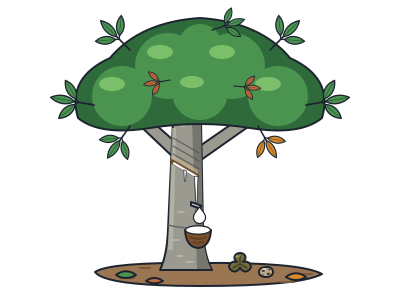
Most car tyres owe something to this tree. Cut its bark and it oozes bright white, sticky latex. That latex is the main source of natural rubber. Its most important use is making tyres, along with seals and tubes.
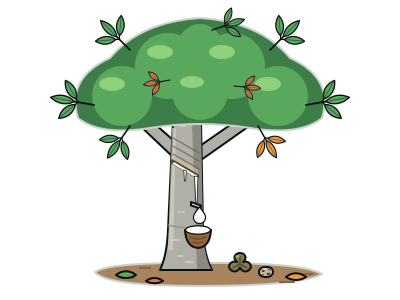
Latex is not the tree's ordinary sap. It flows in its own special tubes in the bark, which spiral around the trunk. Tappers make shallow, slanting cuts and catch the drips. If the cuts are made carefully, the same tree can be tapped again and again without being killed. A tree is usually about 7 to 10 years old before it is tapped for the first time.
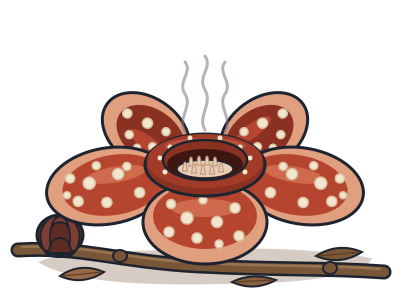
The rubber tree belongs to the spurge family, which has about 7,500 species. Many of them also have milky sap. Its relatives include cassava, the castor oil plant and the Christmas poinsettia. More surprisingly, a genetic study found that the corpse lily's closest relatives are in this same family. Those closest relatives have flowers only a few millimetres across. The corpse lily's flower can be about a metre wide.
The rubber tree grows wild in the warm, wet Amazon rainforest, where there is no frost and at least about 1,200 mm of rain falls each year. Today, though, most rubber trees grow on plantations far away in Southeast Asia.
Taller than a block of flats
Wild rubber trees can grow up to about 43 metres tall, about the height of a 12 to 14-storey building. Tapped trees on plantations stay smaller.
A long journey for seeds
In 1876, about 70,000 rubber seeds were shipped from Brazil to Kew Gardens in London. Only about 4% of them sprouted. Young trees were then sent on to Sri Lanka and to Singapore.
A disease that stays away
In the early 1900s, local diseases badly damaged rubber growing in South America. A fungus called South American leaf blight is still a threat, but it has not yet reached the big plantations in Southeast Asia.
Next to it on the tree
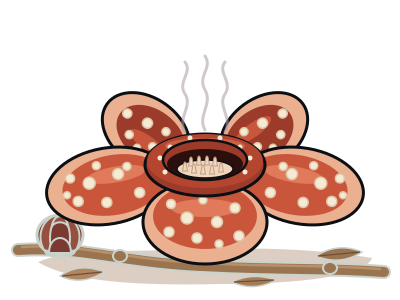
- Corpse lilyThe world's largest single flower, from a parasite with no leaves, stems or roots.
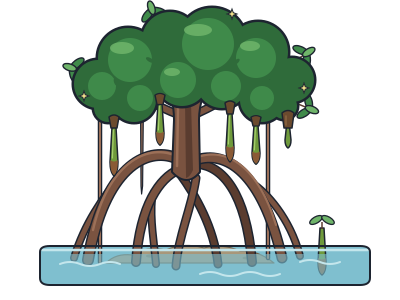
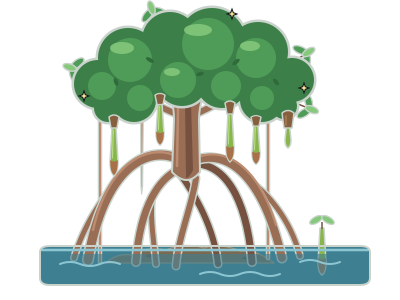
- Red mangroveStands on stilt roots in salt water and drops seedlings that sprout while still on the tree.
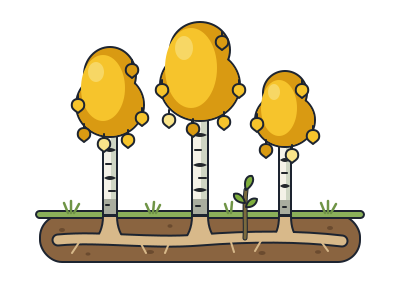
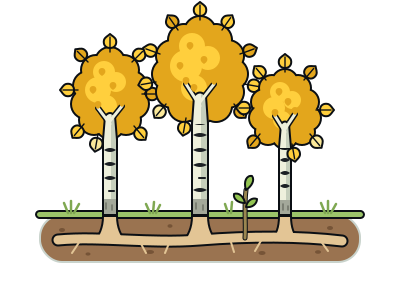
- Quaking aspenOne Utah grove, called Pando, is a single plant with about 47,000 trunks.
- Weeping willowIts drooping branches root easily, and willow bark inspired aspirin.
- CassavaA starchy root that feeds 800 million people but must be cooked to remove its poison.
- Passion fruitAn elaborate flower whose shape reminded missionaries of a religious story.