A species
Monkey puzzle
Araucaria araucana
A spiky tree from the Andes whose family grew alongside the dinosaurs.
You and the monkey puzzle meet in the Eukaryotes branch, shown at about 1.8 billion years ago (on 28 July, in a calendar from life's shared ancestor to today).
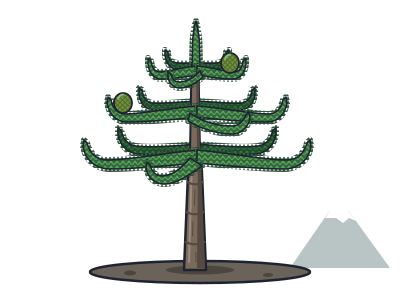
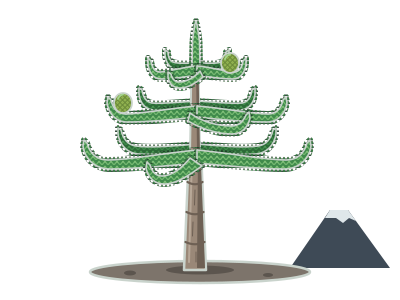
Every branch of this tree is wrapped in stiff, glossy leaves. Each leaf is a thick triangular scale, about 3 to 4 centimetres long, with a sharp, spiny tip. The leaves overlap like a reptile's skin and even cover the young trunk. The name began as a joke in Victorian Britain, when someone said the tree would puzzle a monkey to climb.
The tree belongs to a very old family of conifers. Fossils show that by the middle of the Jurassic period, when giant dinosaurs roamed, the family had spread across both halves of the world. In Patagonia, a petrified forest holds the trunks of an extinct close relative that lived about 165 to 156 million years ago. Some trunks are about 3.5 metres across, about twice as wide as an adult is tall.
It is sometimes called the 'Chile pine', but it is not a pine. Today its family lives mostly in the Southern Hemisphere. One member is the Wollemi pine, which was discovered in an Australian gorge in 1994.
In the wild it grows only on mountain slopes in Chile and Argentina, about 1,000 to 1,700 metres up, often near volcanoes. Its bark can be up to about 15 centimetres thick, and this helps it survive fires. It is now endangered in the wild.
A national symbol
The monkey puzzle is the national tree of Chile. Cutting down wild trees has been banned in Chile since 1990, and international trade in wild trees and their seeds is banned too.
People of the tree
The local name for the tree is pewen. The Pehuenche people's name means 'people of the pewen'. They collect its edible seeds. At harvest time, these can make up about 10 to 15 per cent of the diet in some communities.
Slow-ripening cones
Most trees are either male or female. A female cone can be up to about 20 centimetres across. It takes about 2 to 3 years to ripen and holds about 200 seeds.
Next to it on the tree
- Pine familyPines, spruces, firs and cedars: the conifers of northern forests.
- English yewAlmost every part is poisonous, yet it gave us a cancer drug; some trees are thousands of years old.
- Wollemi pineKnown only from fossils until 1994, when a few trees were found in an Australian canyon.
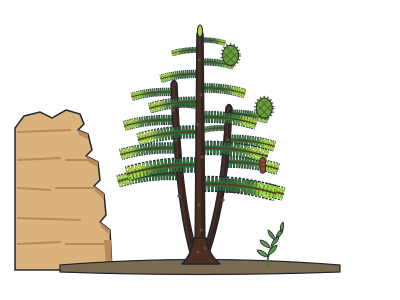
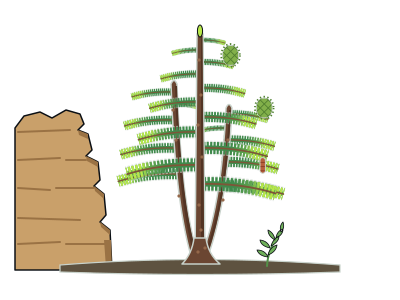
- KauriA giant New Zealand conifer; the biggest living one, Tāne Mahuta, may be 2,000 years old.
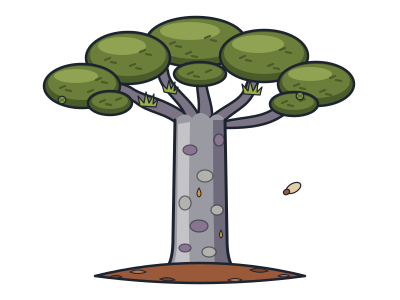
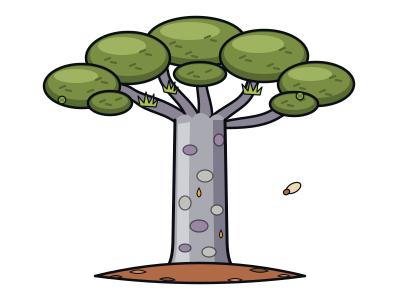
- Cypress familyJunipers, cypresses and redwoods: the conifer family found on every continent but Antarctica.