A species
European beech
Fagus sylvatica
The smooth grey tree whose leafy roof keeps the woodland floor dark
You and the european beech meet in the Eukaryotes branch, shown at about 1.8 billion years ago (on 28 July, in a calendar from life's shared ancestor to today).
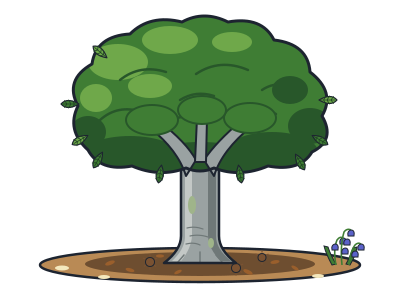
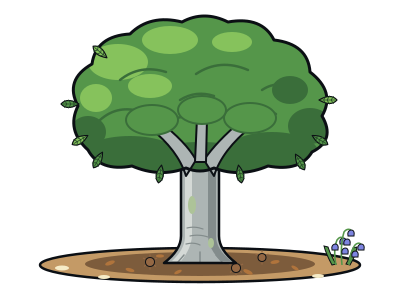
Walk into a beech wood in summer and it feels cool and dim. A grown beech spreads a dense canopy of many branches that lets very little light reach the ground. Its bark is just as easy to spot. It is thin, smooth and silvery-grey, and it usually stays smooth even on old trees.
That smooth bark looks nothing like the deeply cracked bark of an oak, yet oaks are close relatives. Beech belongs to the beech family, together with oaks and sweet chestnuts. In autumn it drops woody, spiky husks about 2 to 3 cm long. Each one splits open to free its nuts, usually two shiny triangular ones.
Beech is one of the best trees in Europe's forests at coping with shade. Its seedlings keep growing in low light, which helps it win out over other trees. Underneath, very little else grows. Bluebells push up through the thick layer of fallen leaves and flower in April and May, before the beech leaves open and shut out the light.
Beeches are often about 25 to 35 metres tall, roughly as tall as a 10-storey building. They usually live about 300 years or more. Birds, mice and squirrels eat the nuts, and bats and insects use the holes in old trunks.
An orchid that needs no light
The bird's-nest orchid grows in the darkest parts of beech woods. It has no green leaves and does not need sunlight. Instead, it takes all its food from fungi in the soil, and those fungi get their food from the roots of the trees around it.
Boom years for nuts
Beech makes huge nut crops only in some years, often after a hot, dry summer, and rarely two years in a row. These big crops usually start once a tree is more than about 30 years old.
One purple ancestor
The purple-leaved copper beech is not a separate species. It is a colour variety of European beech, first recorded in Germany in 1690. About 99% of copper beeches are thought to come from that one tree.
Next to it on the tree
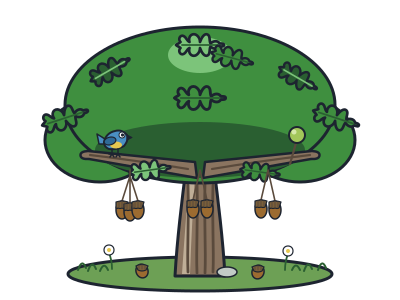
- English oakOne oak can host hundreds of species of insects, birds and fungi.
- Silver birchWhite papery bark and one of the first trees to recolonise land after the Ice Age.
- WalnutIts roots release a chemical that stops other plants growing nearby.
- Sweet chestnutSpiny cases hide the chestnuts roasted on winter streets.