A group of living things
Boletes and kin
Boletales
Spongy-capped tree partners, plus a few cousins that rot wood or look like puffballs
This branch is shown at about 140 million years ago; its age is a rough estimate.
You and boletes and kin meet in the Fungi and animals branch, shown at about 1.3 billion years ago (on 10 September, in a calendar from life's shared ancestor to today).
Most members of this group are tree partners. Their threads wrap around tree roots, so you mostly find them in or near woods. Many are boletes. Instead of the gills most mushrooms have, a bolete has a spongy layer of tiny holes under its cap. But not everyone in the group looks like this, and some of its cousins are surprising.
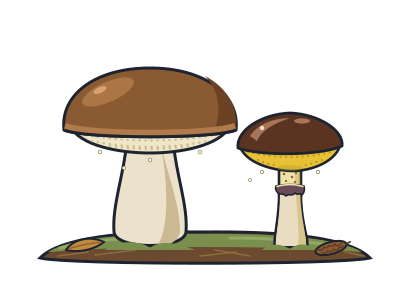
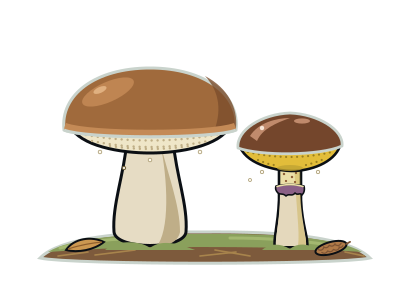
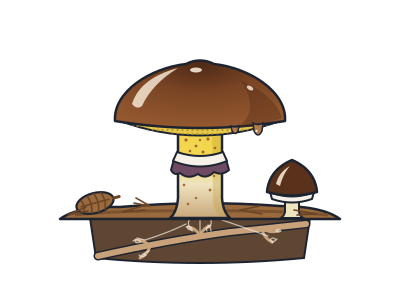
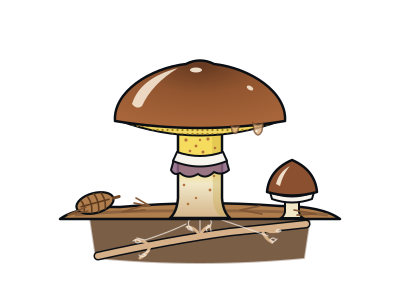
Porcini is a prized food. It is a chunky brown mushroom with a very fat stem. Its cap is usually about 8 to 30 cm across, so the biggest are about as wide as a dinner plate. The slippery jack is smaller and slimmer. It has a slimy brown cap, bright yellow pores and a floppy ring on its stem. It grows with pine trees.
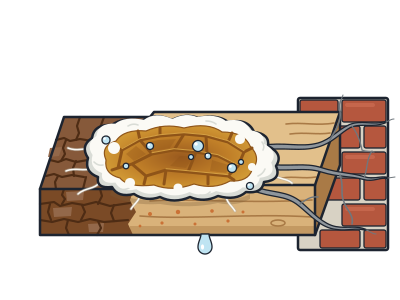
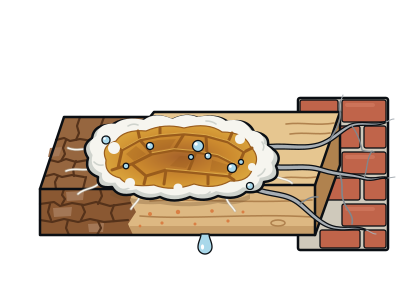
Then there are the odd ones. Earthballs and dye balls look like lumpy puffballs, and a few relatives even have gills. The dry rot fungus does not partner with trees at all. It rots timber in buildings and takes calcium and iron from brick and plaster to help break the wood down. Scientists think the group's earliest ancestor was probably a wood-rotter too.
Not all of them are safe to eat. Some boletes are bitter or poisonous, so never eat a wild mushroom unless an expert has identified it.
Blue when bruised
Many boletes turn blue when cut or bruised. In many species, an orange chemical changes to blue when it meets the air. Turning blue does not, on its own, tell you whether a mushroom is safe or poisonous.
Dry rot needs water
Despite its name, dry rot grows only in damp wood. Its scientific name roughly means 'creeping, making tears', after the water drops that can bead on it.
A record-breaking porcini
A porcini found in Scotland in 1995 weighed 3.2 kg, about as much as a newborn baby. Its cap was 42 cm across, much wider than even a big normal cap.
Inside boletes and kin
- PorciniA fat-stemmed bolete with a sponge of pores instead of gills, loved by cooks.
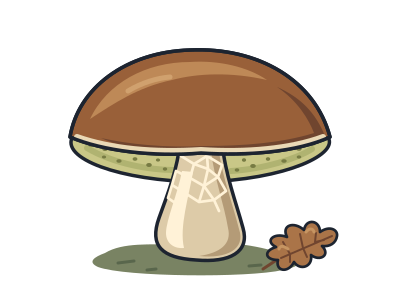
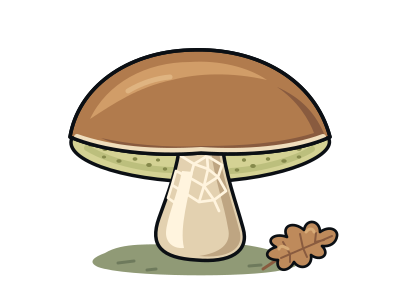
- Slippery jackA slimy brown cap that partners pine roots; it travelled the world with pine plantations.
- Dry rot fungusSpreads through damp houses, turning floorboards to brown cubes; it 'weeps' water drops as it grows.