An extinct species
Amber mushroom †
Archaeomarasmius leggetti
A tiny mushroom caught in tree resin about 90 million years ago.
Lived about 94–90 million years ago.
You and the amber mushroom meet in the Fungi and animals branch, shown at about 1.3 billion years ago (on 10 September, in a calendar from life's shared ancestor to today).
A tiny mushroom, cap and stalk, became trapped in sticky tree resin that later turned into amber. Its fossils dated to about 94 to 90 million years ago. It belonged to the same broad mushroom group as button and oyster mushrooms, but that did not make it their ancestor.
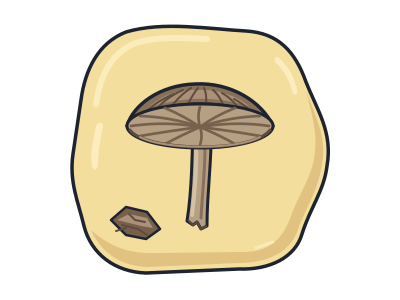
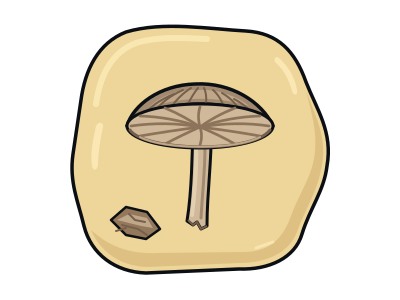
The fossils represented two mushrooms: one complete cap with a broken stalk, and a fragment of another cap. Beneath the complete cap were 12 widely spaced gills—the thin plates under a mushroom’s umbrella. These preserved shapes gave researchers a detailed view of a small, delicate mushroom from the distant past.
Such finds were unusual. Fleshy mushrooms rarely became fossils because they decayed easily and their bodies were short-lived. This one resembled some living mushrooms, but resemblance alone did not reveal its closest relative. The amber preserved clues to its shape, rather than a complete record of how it lived.
A small amber window
The original lump of amber was pale yellow and about 6 centimetres across.
Trapped together
The same amber also contained insects, young spiders and plant fragments.
A New Jersey discovery
The fossil-bearing amber was found at East Brunswick, New Jersey, in November 1994.