A species
Slippery jack
Suillus luteus
A slimy-capped mushroom that partners pine roots and travelled the world with planted pines.
You and the slippery jack meet in the Fungi and animals branch, shown at about 1.3 billion years ago (on 10 September, in a calendar from life's shared ancestor to today).
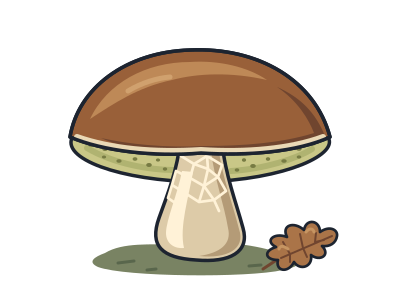
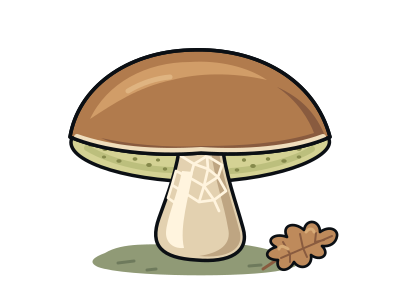
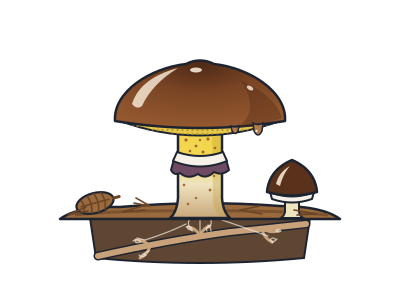
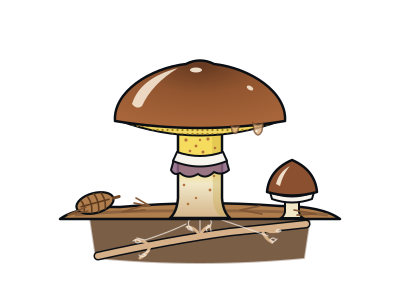
This brown mushroom has a cap coated in shiny slime, and it lives in partnership with pine trees. Underground, its fine threads wrap around pine roots, and the fungus and the tree trade nutrients. In its home range, which stretches from Ireland to Korea, it mostly partners Scots pine.
When people planted pines far from home, the fungus came along too. It now grows in North America, South America, southern Africa, Australia and New Zealand. It is one of the most widely introduced root-partner fungi in the world. It also helps pines spread out of plantations into the wild, where they can become weeds.
Turn the cap over and you won't find gills. Instead there is a yellow sponge of tiny pores, a bit like the underside of its relative, the porcini. Both belong to the wider bolete group. However, scientists now place the slippery jack and its close kin in a family of their own, separate from porcini.
The cap is usually about 4 to 10 centimetres across, roughly the size of your palm. The yellowish stem is dotted with brown speckles. It has a floppy ring that is white on top and purple-brown underneath.
A mushroom crowd
It is a 'pioneer' fungus that appears early in young pine forests. In pine plantations in Ecuador, about 3,000 to 6,000 slippery jacks can come up on a single hectare each year. A hectare is a square about 100 metres on each side.
Butter mushrooms
People eat it in many places, especially in Slavic countries, where its Russian name means roughly 'butter mushrooms'. Cooks usually peel off the slimy skin because it can upset the stomach. Never eat a wild mushroom unless an expert has identified it.
Tough on metals
It has genes that help it cope with heavy metals. On polluted soil it can protect its pine partner from copper and cadmium poisoning.