A species
Wild cabbage
Brassica oleracea
One leafy wild plant that farmers turned into a whole vegetable aisle.
You and the wild cabbage meet in the Eukaryotes branch, shown at about 1.8 billion years ago (on 28 July, in a calendar from life's shared ancestor to today).
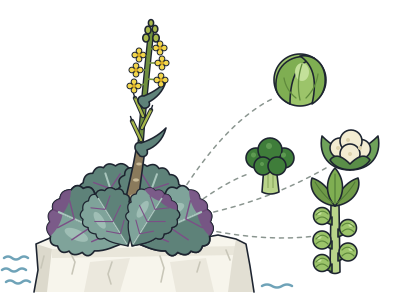
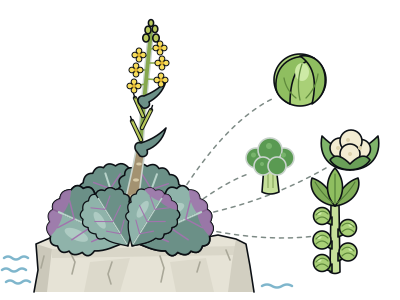
Cabbage, broccoli, cauliflower, kale, kohlrabi and Brussels sprouts look like six different vegetables. In fact they all belong to one species, the same one as wild cabbage. Over many centuries, farmers saved seeds from the plants they liked best. Bit by bit, they turned one wild species into about eight groups of crops. Each group has a different part of the plant made bigger.
Kale is bred for its leaves, and cabbage for a tight head of leaves. The heads of broccoli and cauliflower are clusters of young flowers that have not opened yet. Brussels sprouts are buds growing along the side of the stem, and kohlrabi is a swollen stem. Leafy, kale-like plants were probably the first ones people grew.
Wild-type plants look nothing like a round garden cabbage. Today they grow on chalk and limestone sea cliffs in western Europe, though many of these may be escaped crops that have gone wild again. In its first year the plant makes a loose rosette of thick, waxy, grey-green leaves. In a later year it sends up a spike up to about 1.5 metres tall, covered in yellow flowers with four petals each.
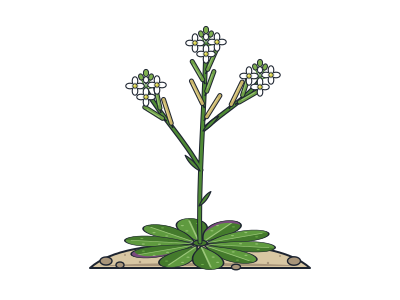
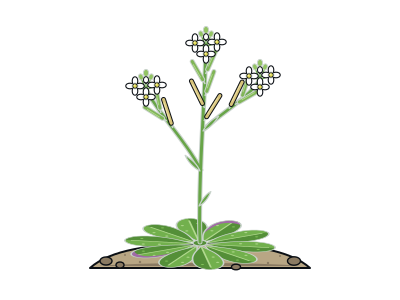
Its relative, thale cress, is a tiny weed that scientists study closely. Wild cabbage's full set of DNA is about five times bigger. Part of the reason is that, long ago, the branch of the family leading to cabbage ended up with three copies of its whole set of genes. Thale cress's branch did not. Those extra gene copies probably helped farmers breed so many different shapes.
Born from a god's sweat
An ancient Greek legend said cabbage sprang up where the god Zeus's sweat hit the ground.
Why sprouts taste bitter to some people
The bitter taste comes from chemicals that contain sulfur. How bitter it tastes to you depends partly on a taste gene you inherited.
Sprouts are newer than you think
The first clear written description of Brussels sprouts dates from 1587. The American president Thomas Jefferson grew them around 1800.